Guppy tank size
Provide an aquarium with a tank length of at least 45 cm. Arrange plants around the edges of the display to maintain an open central swimming area.Provide an aquarium with a tank length of at least 18 in. Arrange plants around the edges of the display to maintain an open central swimming area.[1]
Add floating plants to supply upper shelter without taking up valuable floor space. Floating foliage provides quiet resting cover near the surface while leaving the lower central areas open for active swimming.Add floating plants to supply upper shelter without taking up valuable floor space. Floating foliage provides quiet resting cover near the surface while leaving the lower central areas open for active swimming.[1]
Plan your adult group size before buying a mixed-sex trio. Guppies reproduce readily in home aquariums, which means spare water volume can disappear rapidly as offspring grow.Plan your adult group size before buying a mixed-sex trio. Guppies reproduce readily in home aquariums, which means spare water volume can disappear rapidly as offspring grow.[1]
Guppy water parameters
Choose moderately hard water rather than soft, acidic conditions. Maintain a stable temperature between 18–28 °C, a pH of 7.0–7.8, and a general hardness of 8–15 dGH.Choose moderately hard water rather than soft, acidic conditions. Maintain a stable temperature between 64–82 °F, a pH of 7.0–7.8, and a general hardness of 8–15 dGH.[1]
Cycle the aquarium fully before introducing your fish, and continue testing water parameters regularly after they arrive. Establishing biological filtration protects your livestock from invisible spikes.Cycle the aquarium fully before introducing your fish, and continue testing water parameters regularly after they arrive. Establishing biological filtration protects your livestock from invisible spikes.[3]
Test for ammonia consistently because it forms directly from fish waste and decomposing leftover food. Invisible toxins can accumulate quickly in the aquarium even when the water looks completely clear.Test for ammonia consistently because it forms directly from fish waste and decomposing leftover food. Invisible toxins can accumulate quickly in the aquarium even when the water looks completely clear.[3]
Feeding guppies
Feed adult guppies twice daily. Offer a portion size that your fish can finish completely in about two minutes to avoid leftovers spoiling the water.Feed adult guppies twice daily. Offer a portion size that your fish can finish completely in about two minutes to avoid leftovers spoiling the water.[1][2]
Provide small tropical flakes or micro-pellets as the everyday dietary staple. Introduce occasional feedings of thawed daphnia or brine shrimp to supply balanced nutritional variety for your fish.Provide small tropical flakes or micro-pellets as the everyday dietary staple. Introduce occasional feedings of thawed daphnia or brine shrimp to supply balanced nutritional variety for your fish.[1][2]
Spread each small meal across the water surface rather than dropping food in one spot. Distributing food prevents single fish from claiming a corner and ensures females and smaller individuals eat.Spread each small meal across the water surface rather than dropping food in one spot. Distributing food prevents single fish from claiming a corner and ensures females and smaller individuals eat.[2][3]
Guppy behaviour
Keep guppies in a social group of three or more individuals. Observe how males interact with females, as a male can pursue a female persistently throughout the day.Keep guppies in a social group of three or more individuals. Observe how males interact with females, as a male can pursue a female persistently throughout the day.[1]
Supply dense plant cover to break lines of sight and maintain several females per male in mixed-sex setups. Single-sex groups avoid breeding, provided you watch for chasing and provide adequate space.Supply dense plant cover to break lines of sight and maintain several females per male in mixed-sex setups. Single-sex groups avoid breeding, provided you watch for chasing and provide adequate space.[1]
Expect a typical adult length of about 4 cm, though larger individuals reach 5.1 cm. Practical Fishkeeping notes small fish like guppies live two to five years, depending on genetics and husbandry.Expect a typical adult length of about 2 in, though larger individuals reach 2 in. Practical Fishkeeping notes small fish like guppies live two to five years, depending on genetics and husbandry.[1][6]
Guppy tank mates
Livebearing species like Livebearing species like platiesplaties and and molliesmollies make suitable companions in mineral-rich water. Ensure your tank volume accommodates their larger adult sizes and the extra young they produce. make suitable companions in mineral-rich water. Ensure your tank volume accommodates their larger adult sizes and the extra young they produce.[1]
A group of A group of bronze corydorasbronze corydoras provides peaceful bottom activity, while a provides peaceful bottom activity, while a bristlenose plecobristlenose pleco fits well if there is ample floor space and shelter. Feed these bottom dwellers directly with sinking foods. fits well if there is ample floor space and shelter. Feed these bottom dwellers directly with sinking foods.[1][2]
Avoid nippy species such as Avoid nippy species such as tiger barbstiger barbs, which damage long guppy fins. Large predatory fish like , which damage long guppy fins. Large predatory fish like oscarsoscars and aggressive and aggressive Jack DempseysJack Dempseys must also be excluded because they bully or swallow small tank mates. must also be excluded because they bully or swallow small tank mates.[1][7][8]
Usually fine together
- African butterfly cichlid
- African clawed frog
- Agassiz's cory
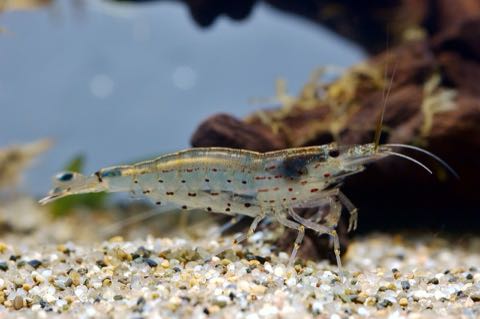 Amano shrimp
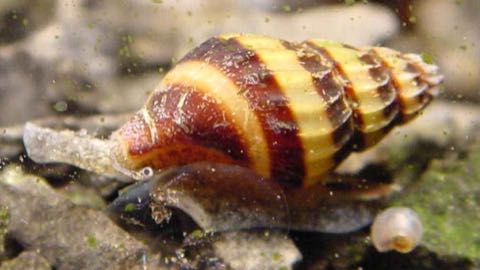 Assassin snail
- Banded gourami
- Bandit cory
- Banjo catfish
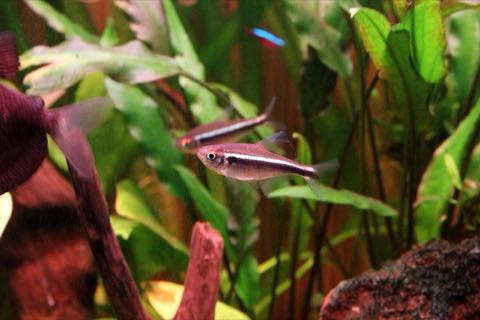 Black neon tetra
- Black phantom tetra
- Black ruby barb
- Blackline rasbora
Avoid with
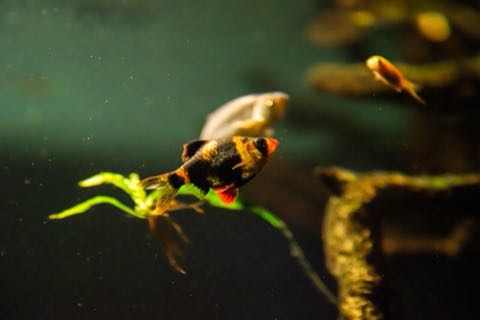 Tiger barb
 may nip the long fins of GuppyTiger barb may nip the long fins of Guppy
- American flagfish
American flagfish may nip GuppyAmerican flagfish may nip Guppy
- Blind cave tetra
Blind cave tetra may nip GuppyBlind cave tetra may nip Guppy
- Buenos Aires tetra
Buenos Aires tetra may nip GuppyBuenos Aires tetra may nip Guppy
- Butterfly splitfin
Butterfly splitfin may nip GuppyButterfly splitfin may nip Guppy
- Chinese barb
Chinese barb may nip GuppyChinese barb may nip Guppy
- Colombian tetra
Colombian tetra may nip GuppyColombian tetra may nip Guppy
- Red eye tetra
Red eye tetra may nip GuppyRed eye tetra may nip Guppy
- Silvertip tetra
Silvertip tetra may nip GuppySilvertip tetra may nip Guppy
- Ticto barb
Ticto barb may nip GuppyTicto barb may nip Guppy
- African knifefish
African knifefish may eat GuppyAfrican knifefish may eat Guppy
- African pike
African pike may eat GuppyAfrican pike may eat Guppy
Breeding guppies
Guppies reproduce by giving birth to live, free-swimming young rather than laying eggs. A female can produce a brood roughly every four to six weeks, though adult fish may eat unprotected fry.Guppies reproduce by giving birth to live, free-swimming young rather than laying eggs. A female can produce a brood roughly every four to six weeks, though adult fish may eat unprotected fry.[1]
Buying only female fish does not prevent unexpected offspring. Female guppies can store viable sperm from prior matings and drop multiple broods over several months without a male present.Buying only female fish does not prevent unexpected offspring. Female guppies can store viable sperm from prior matings and drop multiple broods over several months without a male present.[1]
Guppy health problems
Fin rot appears as frayed, receding fin edges that can show visible redness. Long ornamental tails make physical damage obvious, often triggered by bacterial infection following poor water conditions, stress, or fin-nipping tank mates.Fin rot appears as frayed, receding fin edges that can show visible redness. Long ornamental tails make physical damage obvious, often triggered by bacterial infection following poor water conditions, stress, or fin-nipping tank mates.[4]
Ich presents as distinct white dots scattered across the body and fins, frequently accompanied by rapid breathing or rubbing against hardscape. The parasite spreads via introduced fish or contaminated tools rather than developing spontaneously.Ich presents as distinct white dots scattered across the body and fins, frequently accompanied by rapid breathing or rubbing against hardscape. The parasite spreads via introduced fish or contaminated tools rather than developing spontaneously.[5]
Velvet causes a fine yellow-gold dusting over the skin, featuring spots much smaller than those seen with ich. Quarantine new arrivals for 30 days and investigate any abnormal powdery sheen paired with lethargic behaviour.Velvet causes a fine yellow-gold dusting over the skin, featuring spots much smaller than those seen with ich. Quarantine new arrivals for 30 days and investigate any abnormal powdery sheen paired with lethargic behaviour.[5][4]
Male or female?
Examine the anal fin underneath the fish to identify sex. Males possess a narrow, rod-like gonopodium used during mating, whereas females have a broad, standard fin.Examine the anal fin underneath the fish to identify sex. Males possess a narrow, rod-like gonopodium used during mating, whereas females have a broad, standard fin.[1]
Females generally have a larger adult length and a fuller, rounder body profile. Do not rely solely on bright coloration to identify males, as domestic female strains can display vibrant ornamental tails.Females generally have a larger adult length and a fuller, rounder body profile. Do not rely solely on bright coloration to identify males, as domestic female strains can display vibrant ornamental tails.[1]
Questions
Is a guppy easy to take care of?
Yes, guppies adapt well to community setups when given moderately hard water, cycled filtration, and regular small meals twice daily.Yes, guppies adapt well to community setups when given moderately hard water, cycled filtration, and regular small meals twice daily.[1][3][2]
How many guppies should I keep together?
Keep a social group of at least three guppies. When mixing sexes, maintain several females for each male to distribute breeding attention.Keep a social group of at least three guppies. When mixing sexes, maintain several females for each male to distribute breeding attention.[1]
How do I know if guppies are happy?
Healthy guppies swim actively, eat readily within two minutes, display intact fins, and show smooth scales free of white spots or gold dust.Healthy guppies swim actively, eat readily within two minutes, display intact fins, and show smooth scales free of white spots or gold dust.[1][2][4][5]
Do I feed guppies every day?
Yes, feed adult guppies twice every day. Offer small tropical flakes, micro-pellets, or thawed invertebrates in amounts they consume in two minutes.Yes, feed adult guppies twice every day. Offer small tropical flakes, micro-pellets, or thawed invertebrates in amounts they consume in two minutes.[1][2]
Can one guppy live alone?
No, guppies need a social group of three or more fish to support normal activity and interaction in the aquarium.No, guppies need a social group of three or more fish to support normal activity and interaction in the aquarium.[1]
Sources
- Poecilia reticulata (Guppy) — Seriously Fish. Accessed 2026-10-05.
- What to feed your fish — RSPCA. Accessed 2026-10-05.
- Ammonia in Aquatic Systems — UF/IFAS Extension. Accessed 2026-10-05.
- Frequently asked questions on treating sick fish — Practical Fishkeeping. Accessed 2026-10-05.
- Ichthyophthirius multifiliis (White Spot) Infections in Fish — UF/IFAS Extension. Accessed 2026-10-05.
- How Long Should My Fish Live? — Practical Fishkeeping. Accessed 2026-10-05.
- Astronotus ocellatus (Oscar) — Seriously Fish. Accessed 2026-10-05.
- Rocio octofasciata (Jack Dempsey) — Seriously Fish. Accessed 2026-10-05.
Written from the sources above. Not yet reviewed by an aquarist.
Data used by the planner
| Temperature range | 18–28 | AqAdvisor (aqadvisor.com), retrieved 2026-10-04; agrees with FishBase (fishbase.se), retrieved 2026-10-04 · medium confidence |
|---|---|---|
| pH | 5.5–7.8 | AqAdvisor (aqadvisor.com), retrieved 2026-10-04 · low confidence |
| Hardness (dGH) | 1–15 | AqAdvisor (aqadvisor.com), retrieved 2026-10-04 · low confidence |
| Origin | Central and northern South America | curated-v0 (needs expert review) · low confidence |
| Beginner friendly | Yes | curated-v0 (needs expert review) · medium confidence |
| Care level | easy | curated-v0 (needs expert review) · medium confidence |
| Activity | moderate | curated-v0 (needs expert review) · medium confidence |
| Swimming level | top | curated-v0 (needs expert review) · medium confidence |
| Temperament | peaceful | curated-v0 (needs expert review) · medium confidence |
| Nips fins | No | curated-v0 (needs expert review) · medium confidence |
| Long fins | Yes | curated-v0 (needs expert review) · medium confidence |
| Territorial | No | curated-v0 (needs expert review) · medium confidence |
| Lives in groups | No | curated-v0 (needs expert review) · medium confidence |
| Minimum group | 1 | curated-v0 (needs expert review) · medium confidence |
| Diet | omnivore | curated-v0 (needs expert review) · medium confidence |
| Lifespan (years) | 3–6 | curated-v0 (needs expert review) · low confidence |
| Months to adult size | 12 | curated-v0 (needs expert review) · low confidence |
| Safe with plants | Yes | curated-v0 (needs expert review) · medium confidence |
| Minimum tank length | 45 | curated-v0 (needs expert review) · medium confidence |