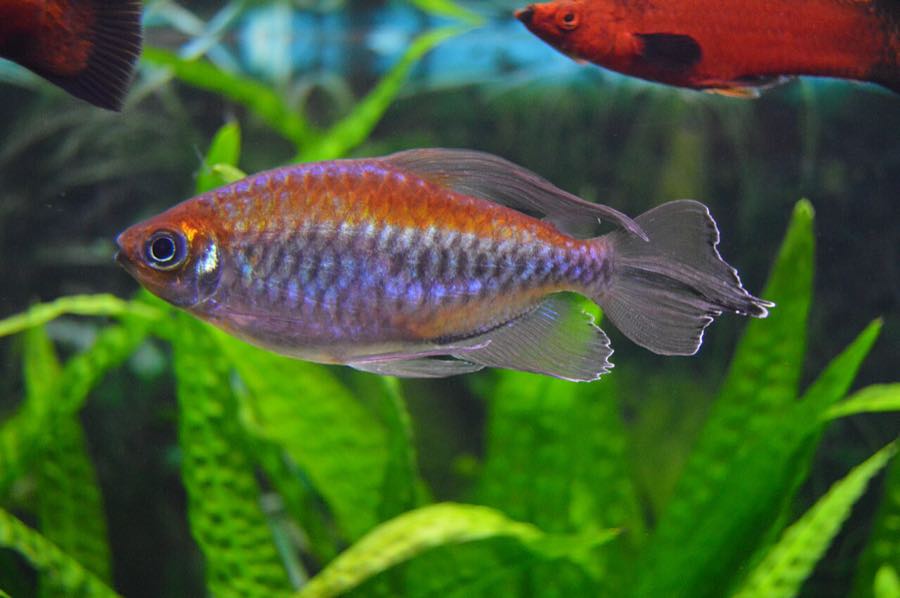
Congo tetra tank size
House adult Congo tetras in an aquarium with a minimum tank length of 120 cm. This species swims actively and requires an open route through the aquarium. Tetra recommends an aquarium capacity of at least 200 L, but tank length remains important even where the stated volume is met.House adult Congo tetras in an aquarium with a minimum tank length of about 4 ft (47 in). This species swims actively and requires an open route through the aquarium. Tetra recommends an aquarium capacity of at least 52.8 gal, but tank length remains important even where the stated volume is met.[1][6]
Plant the back and sides and add driftwood, floating cover, and shaded retreats. These additions provide shelter without filling the central swimming area needed by the fish.Plant the back and sides and add driftwood, floating cover, and shaded retreats. These additions provide shelter without filling the central swimming area needed by the fish.[1][6]
Congo tetra water parameters
Maintain the water temperature between 23–27 °C. Keep the water chemistry stable within a pH range of 6.0–7.5 and a hardness between 5–15 dGH. Maintaining stability and clean water matters for male fin development and colour.Maintain the water temperature between 73–81 °F. Keep the water chemistry stable within a pH range of 6.0–7.5 and a hardness between 5–15 dGH. Maintaining stability and clean water matters for male fin development and colour.[1][6]
A mature biological filter processes fish waste. Test ammonia regularly and immediately when fish stop feeding or behave abnormally. Ammonia should be undetectable, as overfeeding and impaired filtration can raise it, causing tissue damage and greater vulnerability to infection.A mature biological filter processes fish waste. Test ammonia regularly and immediately when fish stop feeding or behave abnormally. Ammonia should be undetectable, as overfeeding and impaired filtration can raise it, causing tissue damage and greater vulnerability to infection.[3]
Feeding congo tetra
Congo tetras are omnivores taking small invertebrates and some algae in nature. Use suitable prepared food with live or frozen foods, such as bloodworms and other frozen invertebrates, as part of a varied diet, and plant-based dry food can provide variety. A practical starting feeding routine is two small meals daily, with portions eaten in about two minutes; adjust portions to fish size and remove uneaten food.Congo tetras are omnivores taking small invertebrates and some algae in nature. Use suitable prepared food with live or frozen foods, such as bloodworms and other frozen invertebrates, as part of a varied diet, and plant-based dry food can provide variety. A practical starting feeding routine is two small meals daily, with portions eaten in about two minutes; adjust portions to fish size and remove uneaten food.[1][6][2]
Congo tetra behaviour
Congo tetras are peaceful midwater swimmers that can intimidate very shy small fish through their size and movement. Juveniles may look plain grey, but mature fish develop iridescent red and blue colouring naturally rather than needing artificial colour enhancement. Tetra reports that well-kept Congo tetras can live up to ten years as an upper lifespan.Congo tetras are peaceful midwater swimmers that can intimidate very shy small fish through their size and movement. Juveniles may look plain grey, but mature fish develop iridescent red and blue colouring naturally rather than needing artificial colour enhancement. Tetra reports that well-kept Congo tetras can live up to ten years as an upper lifespan.[1][6]
Keep at least six Congo tetras in the aquarium. A mixed-sex shoal displays social behaviour better than isolated fish. Adult length reaches about 8 cm standard length, so leave an open route through the aquarium for active swimming.Keep at least six Congo tetras in the aquarium. A mixed-sex shoal displays social behaviour better than isolated fish. Adult length reaches about 3 in standard length, so leave an open route through the aquarium for active swimming.[1][6]
Congo tetra tank mates
A group of A group of bronze corydorasbronze corydoras is a conditional bottom-dwelling choice when provided with their own group and food in shared suitable water. Similarly, is a conditional bottom-dwelling choice when provided with their own group and food in shared suitable water. Similarly, bristlenose plecosbristlenose plecos can use the lower levels while the shoal swims above, provided you supply their own space and food. can use the lower levels while the shoal swims above, provided you supply their own space and food.[1]
Boesemani rainbowfishBoesemani rainbowfish are a conditional option in a roomy tank with overlapping water requirements, provided you preserve swimming space for both active groups. are a conditional option in a roomy tank with overlapping water requirements, provided you preserve swimming space for both active groups. Keyhole cichlidsKeyhole cichlids are a named peaceful-cichlid option; retain shelters and observe any breeding territory. are a named peaceful-cichlid option; retain shelters and observe any breeding territory.[1]
Avoid Avoid oscarsoscars, because large adults are predatory toward much smaller fish. Avoid , because large adults are predatory toward much smaller fish. Avoid Jack DempseysJack Dempseys in this peaceful shoal setup, as territorial mature cichlids pose an unnecessary harassment risk. In addition, avoid in this peaceful shoal setup, as territorial mature cichlids pose an unnecessary harassment risk. In addition, avoid pea pufferspea puffers, whose tendency to nip long fins puts adult male Congo tetras at risk., whose tendency to nip long fins puts adult male Congo tetras at risk.[7][8][1][9]
Usually fine together
- African butterfly cichlid
- Agassiz's cory
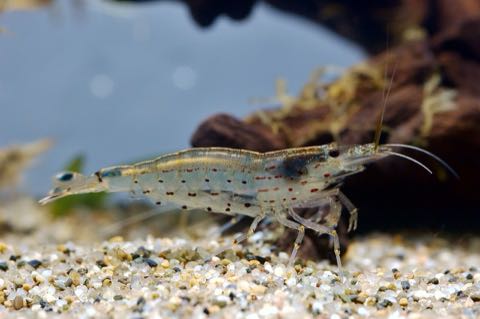 Amano shrimp
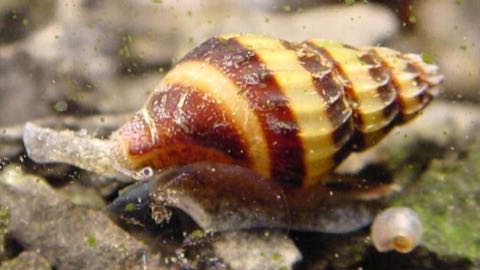 Assassin snail
- Banded gourami
- Bandit cory
- Banjo catfish
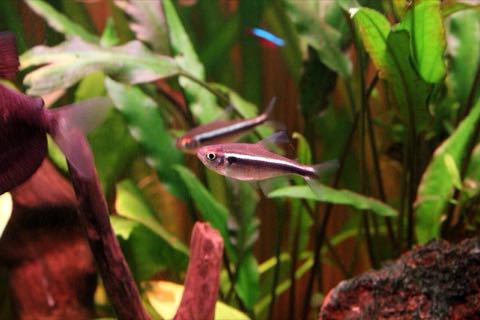 Black neon tetra
- Black phantom tetra
- Black ruby barb
- Blackline rasbora
- Bleeding heart tetra
Avoid with
- Acei cichlid
No shared pH rangeNo shared pH range
- American flagfish
American flagfish may nip Congo tetraAmerican flagfish may nip Congo tetra
- Blind cave tetra
Blind cave tetra may nip Congo tetraBlind cave tetra may nip Congo tetra
- Brevis shell dweller
No shared pH rangeNo shared pH range
- Buenos Aires tetra
Buenos Aires tetra may nip Congo tetraBuenos Aires tetra may nip Congo tetra
- Butterfly splitfin
Butterfly splitfin may nip Congo tetraButterfly splitfin may nip Congo tetra
- Caudopunctatus
No shared pH rangeNo shared pH range
- Chinese barb
Chinese barb may nip Congo tetraChinese barb may nip Congo tetra
- Colombian tetra
Colombian tetra may nip Congo tetraColombian tetra may nip Congo tetra
- Multies
No shared pH rangeNo shared pH range
- Pindani
No shared pH rangeNo shared pH range
- Red eye tetra
Red eye tetra may nip Congo tetraRed eye tetra may nip Congo tetra
Breeding congo tetra
Congo tetras scatter eggs and can consume them, so breeding needs a separate, dimly lit tank with vegetation and an egg-protecting mesh. Condition prospective parents with live and frozen food, and select a colourful male and a female filled with eggs.Congo tetras scatter eggs and can consume them, so breeding needs a separate, dimly lit tank with vegetation and an egg-protecting mesh. Condition prospective parents with live and frozen food, and select a colourful male and a female filled with eggs.[1]
Remove visibly fungused eggs promptly. Prepare infusoria for the first feeding stage before moving the growing fry to brine shrimp nauplii or microworms.Remove visibly fungused eggs promptly. Prepare infusoria for the first feeding stage before moving the growing fry to brine shrimp nauplii or microworms.[1]
Congo tetra health problems
Ich is a parasitic infection that can produce white spots, rubbing, clamped fins, and laboured breathing, though some gill infections have no obvious body spots. Ich can arrive on fish or wet equipment; quarantine new fish for at least 30 days and avoid sharing uncleaned nets between aquariums.Ich is a parasitic infection that can produce white spots, rubbing, clamped fins, and laboured breathing, though some gill infections have no obvious body spots. Ich can arrive on fish or wet equipment; quarantine new fish for at least 30 days and avoid sharing uncleaned nets between aquariums.[5]
Fin rot is usually a bacterial problem associated with poor conditions, marked by fins that keep fraying or shrinking and blood-streaked edges. Reduce fin-rot risk by maintaining water quality and removing harassment or injury sources, and assess progressive damage promptly.Fin rot is usually a bacterial problem associated with poor conditions, marked by fins that keep fraying or shrinking and blood-streaked edges. Reduce fin-rot risk by maintaining water quality and removing harassment or injury sources, and assess progressive damage promptly.[4]
Fungal cotton-wool disease produces fluffy white or grey growth on damaged tissue, where injury and environmental stress allow fungi to gain a foothold. Prevent fungal problems by avoiding sharp decor and rough handling and correcting poor water conditions; fuzzy growth warrants prompt diagnosis because mouth rot can resemble fungus.Fungal cotton-wool disease produces fluffy white or grey growth on damaged tissue, where injury and environmental stress allow fungi to gain a foothold. Prevent fungal problems by avoiding sharp decor and rough handling and correcting poor water conditions; fuzzy growth warrants prompt diagnosis because mouth rot can resemble fungus.[4]
Male or female?
Mature males are larger and more colourful, with elongated central tail rays and an extended dorsal fin, whereas females have less dramatic fins. Juvenile drabness is normal and does not by itself establish sex or poor health.Mature males are larger and more colourful, with elongated central tail rays and an extended dorsal fin, whereas females have less dramatic fins. Juvenile drabness is normal and does not by itself establish sex or poor health.[1][6]
Questions
How many Congo tetras should be kept together?
Keep at least six Congo tetras together in the aquarium. A mixed-sex shoal displays social behaviour better than isolated fish.Keep at least six Congo tetras together in the aquarium. A mixed-sex shoal displays social behaviour better than isolated fish.[1][6]
What is the lifespan of a Congo Tetra?
Tetra reports that well-kept Congo tetras can live up to ten years as an upper lifespan.Tetra reports that well-kept Congo tetras can live up to ten years as an upper lifespan.[6]
How do I care for a Congo Tetra?
Provide a minimum tank length of 120 cm with an open swimming route, maintain water at 23–27 °C with a pH of 6.0–7.5, and feed suitable prepared food alongside live or frozen items.Provide a minimum tank length of about 4 ft (47 in) with an open swimming route, maintain water at 73–81 °F with a pH of 6.0–7.5, and feed suitable prepared food alongside live or frozen items.[1][6]
Are Congo tetras hard to keep?
Success requires meeting key conditions: a minimum tank length of 120 cm, clean and stable water at 23–27 °C, undetectable ammonia, and a group of at least six fish.Success requires meeting key conditions: a minimum tank length of about 4 ft (47 in), clean and stable water at 73–81 °F, undetectable ammonia, and a group of at least six fish.[1][6][3]
What tank size does a Congo tetra need?
Adult Congo tetras need a minimum tank length of 120 cm with an open route for active swimming. Tetra recommends at least 200 L, but horizontal length remains essential.Adult Congo tetras need a minimum tank length of about 4 ft (47 in) with an open route for active swimming. Tetra recommends at least 52.8 gal, but horizontal length remains essential.[1][6]
Sources
- Phenacogrammus interruptus (Congo Tetra) — Seriously Fish. Accessed 2026-10-05.
- What to feed your fish — RSPCA. Accessed 2026-10-05.
- Ammonia in Aquatic Systems — UF/IFAS Extension. Accessed 2026-10-05.
- Frequently asked questions on treating sick fish — Practical Fishkeeping. Accessed 2026-10-05.
- Ichthyophthirius multifiliis (White Spot) Infections in Fish — UF/IFAS Extension. Accessed 2026-10-05.
- Congo tetra (Phenacogrammus interruptus) — Tetra. Accessed 2026-10-05.
- Astronotus ocellatus (Oscar) — Seriously Fish. Accessed 2026-10-05.
- Rocio octofasciata (Jack Dempsey) — Seriously Fish. Accessed 2026-10-05.
- Carinotetraodon travancoricus (Dwarf Puffer) — Seriously Fish. Accessed 2026-10-05.
Written from the sources above. Not yet reviewed by an aquarist.
Data used by the planner
| Temperature | 23–27 | AqAdvisor (aqadvisor.com), retrieved 2026-10-04; agrees with FishBase (fishbase.se), retrieved 2026-10-04 · medium confidence |
|---|---|---|
| pH | 5.5–7.5 | AqAdvisor (aqadvisor.com), retrieved 2026-10-04; agrees with FishBase (fishbase.se), retrieved 2026-10-04 · medium confidence |
| Hardness (dGH) | 5–15 | AqAdvisor (aqadvisor.com), retrieved 2026-10-04 · low confidence |
| Origin | Congo basin, Africa | curated-v0 (needs expert review) · medium confidence |
| Beginner friendly | Yes | curated-v0 (needs expert review) · medium confidence |
| Care level | easy | curated-v0 (needs expert review) · medium confidence |
| Activity | active | curated-v0 (needs expert review) · medium confidence |
| Swimming level | middle | curated-v0 (needs expert review) · medium confidence |
| Temperament | peaceful | curated-v0 (needs expert review) · medium confidence |
| Nips fins | No | curated-v0 (needs expert review) · medium confidence |
| Long fins | Yes | curated-v0 (needs expert review) · medium confidence |
| Territorial | No | curated-v0 (needs expert review) · medium confidence |
| Lives in groups | Yes | curated-v0 (needs expert review) · medium confidence |
| Minimum group | 6 | curated-v0 (needs expert review) · medium confidence |
| Diet | omnivore | curated-v0 (needs expert review) · medium confidence |
| Lifespan (years) | 5–10 | curated-v0 (needs expert review) · low confidence |
| Months to adult size | 12 | curated-v0 (needs expert review) · low confidence |
| Safe with plants | Yes | curated-v0 (needs expert review) · medium confidence |
| Minimum tank length | 120 | curated-v0 (needs expert review) · medium confidence |