Multifasciatus shell dweller tank size
Start with at least 45 cm tank length and 30 cm tank width for a pair. Colonies need a larger footprint than this minimum base area. Adults reach an adult length of about 4.5 cm standard length. The species is endemic to Lake Tanganyika and lives around shell accumulations on soft bottom.Start with at least 18 in tank length and 12 in tank width for a pair. Colonies need a larger footprint than this minimum base area. Adults reach an adult length of about 1.8 in standard length. The species is endemic to Lake Tanganyika and lives around shell accumulations on soft bottom.[1]
Use sandy substrate that lets the fish dig and provide an open shell bed. Supply more empty snail shells than there are fish in the aquarium. Shell provision reduces competition among the fish, but it does not prevent all severe competition.Use sandy substrate that lets the fish dig and provide an open shell bed. Supply more empty snail shells than there are fish in the aquarium. Shell provision reduces competition among the fish, but it does not prevent all severe competition.[1]
Multifasciatus shell dweller water parameters
Keep water within routine overlapping targets of 24–27 °C, pH 7.6–9.0, and 10–25 dGH. Maintaining these specific conditions provides the appropriate water chemistry for the aquarium.Keep water within routine overlapping targets of 75–81 °F, pH 7.6–9.0, and 10–25 dGH. Maintaining these specific conditions provides the appropriate water chemistry for the aquarium.[1]
Feeding multifasciatus shell dwellers
Live and frozen food should make up much of the diet, though suitably sized dry food is usually accepted. Daphnia or brine shrimp serve as general supplements; select particles small enough for these small cichlids.Live and frozen food should make up much of the diet, though suitably sized dry food is usually accepted. Daphnia or brine shrimp serve as general supplements; select particles small enough for these small cichlids.[1][2]
Offer two or three small meals daily, feeding only what is consumed in 2–5 minutes, and adjust portions to the fish present. Avoid excess uneaten food because it can decay and worsen water quality.Offer two or three small meals daily, feeding only what is consumed in 2–5 minutes, and adjust portions to the fish present. Avoid excess uneaten food because it can decay and worsen water quality.[2]
Multifasciatus shell dweller behaviour
These are territorial shell dwellers rather than schooling fish. They defend the shell and surrounding space vigorously against intruders in the aquarium.These are territorial shell dwellers rather than schooling fish. They defend the shell and surrounding space vigorously against intruders in the aquarium.[1]
Groups can form colonies. Provide ample shells and more females than males; this reduces conflict but does not eliminate aggression. They dig and partially bury shells until entrances remain exposed.Groups can form colonies. Provide ample shells and more females than males; this reduces conflict but does not eliminate aggression. They dig and partially bury shells until entrances remain exposed.[1]
Multifasciatus shell dweller tank mates
A dedicated colony is the simpler arrangement. Potential companions are alternatives for a substantially larger aquarium with separate shell, rock, and open-water areas, not additions to the minimum pair tank. Monitor territory disputes whenever combining species.A dedicated colony is the simpler arrangement. Potential companions are alternatives for a substantially larger aquarium with separate shell, rock, and open-water areas, not additions to the minimum pair tank. Monitor territory disputes whenever combining species.[1][8]
Masked juliesMasked julies are a conditional small rock-dweller candidate that occupy rocky habitat; separate rocks from shells and monitor territory disputes. are a conditional small rock-dweller candidate that occupy rocky habitat; separate rocks from shells and monitor territory disputes. Golden juliesGolden julies can be considered as a pair with their own rock territory because can be considered as a pair with their own rock territory because golden juliesgolden julies occupy different areas from Neolamprologus shell dwellers. occupy different areas from Neolamprologus shell dwellers.[1][8][9]
Dickfeld’s juliesDickfeld’s julies are another conditional paired rock-dweller alternative with a separate territory and sufficient room; are another conditional paired rock-dweller alternative with a separate territory and sufficient room; Dickfeld’s juliesDickfeld’s julies are aggressive toward fish of the same species. are aggressive toward fish of the same species. Sardine cichlidsSardine cichlids use open water, but only consider a larger tank that accommodates the swimming needs and shoal of use open water, but only consider a larger tank that accommodates the swimming needs and shoal of sardine cichlidssardine cichlids..[10][11]
Avoid predatory cichlids such as Avoid predatory cichlids such as oscarsoscars, whose predatory behaviour puts very small fish at risk. Avoid , whose predatory behaviour puts very small fish at risk. Avoid Jack DempseysJack Dempseys, as the large cichlid profile requires companions too large to swallow. Avoid , as the large cichlid profile requires companions too large to swallow. Avoid pea pufferspea puffers, whose fin-nipping risk makes , whose fin-nipping risk makes pea pufferspea puffers a poor addition to this territorial cichlid arrangement. a poor addition to this territorial cichlid arrangement.[5][6][7]
Usually fine together
- Acei cichlid
- American flagfish
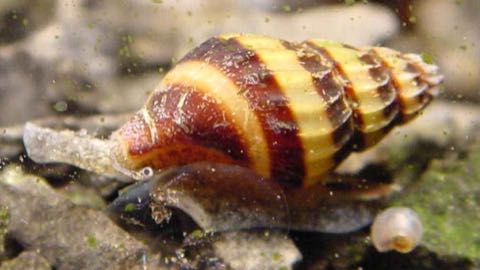 Assassin snail
- Blood parrot cichlid
- Blue rainbowfish
- Brevis shell dweller
- Butterfly splitfin
- Caudopunctatus
- Chinese mystery snail
- Horned nerite snail
- Malaysian trumpet snail
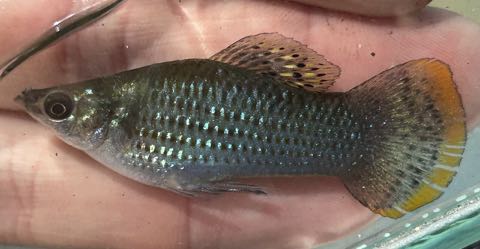 Molly
Avoid with
- African clawed frog
African clawed frog may eat MultiesAfrican clawed frog may eat Multies
- Banded gourami
No shared pH rangeNo shared pH range
- Bandit cory
No shared pH rangeNo shared pH range
- Black kuhli loach
No shared pH rangeNo shared pH range
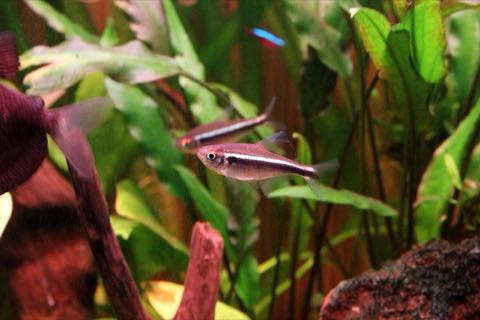 Black neon tetra
No shared pH rangeNo shared pH range
- Black phantom tetra
No shared pH rangeNo shared pH range
- Blackline rasbora
No shared pH rangeNo shared pH range
- Bleeding heart tetra
No shared pH rangeNo shared pH range
- Blind cave tetra
No shared pH rangeNo shared pH range
- Bloodfin tetra
No shared pH rangeNo shared pH range
- Blue acara
No shared pH rangeNo shared pH range
- Blue emperor tetra
No shared pH rangeNo shared pH range
Breeding multifasciatus shell dwellers
Females lay eggs within empty shells and guard the opening. A separate breeding aquarium helps protect a brood from other colony fish, as other colony fish may eat fry.Females lay eggs within empty shells and guard the opening. A separate breeding aquarium helps protect a brood from other colony fish, as other colony fish may eat fry.[1]
Eggs hatch at about one day and fry become free-swimming around day six or seven under typical conditions. Free-swimming fry can take brine shrimp nauplii or microworm.Eggs hatch at about one day and fry become free-swimming around day six or seven under typical conditions. Free-swimming fry can take brine shrimp nauplii or microworm.[1]
Multifasciatus shell dweller health problems
Ich is a freshwater parasite infection where salt-like white spots, rubbing, reduced appetite, and gill irritation are possible signs. Appearance alone does not confirm diagnosis; obtain prompt qualified advice. A 30-day quarantine for arrivals and separate or disinfected nets help prevent introduction of ich.Ich is a freshwater parasite infection where salt-like white spots, rubbing, reduced appetite, and gill irritation are possible signs. Appearance alone does not confirm diagnosis; obtain prompt qualified advice. A 30-day quarantine for arrivals and separate or disinfected nets help prevent introduction of ich.[3]
Fin rot can cause fraying and red streaks followed by shrinking fins. Bacterial disease is encouraged by poor conditions and stress. Prevent avoidable fin rot by maintaining water quality and removing sources of injury or harassment; seek assessment if fins deteriorate.Fin rot can cause fraying and red streaks followed by shrinking fins. Bacterial disease is encouraged by poor conditions and stress. Prevent avoidable fin rot by maintaining water quality and removing sources of injury or harassment; seek assessment if fins deteriorate.[4]
Fungal infection can appear as grey-white cottony growth on damaged skin, occurring when injury and environmental stress weaken the protective mucus. Smooth furnishings, gentle handling, and good water quality reduce injuries that allow fungus to establish; cottony growth warrants prompt advice.Fungal infection can appear as grey-white cottony growth on damaged skin, occurring when injury and environmental stress weaken the protective mucus. Smooth furnishings, gentle handling, and good water quality reduce injuries that allow fungus to establish; cottony growth warrants prompt advice.[4]
Male or female?
Adult males are substantially larger, somewhat more colourful, and may show red on the upper dorsal fin. Juveniles are difficult to sex.Adult males are substantially larger, somewhat more colourful, and may show red on the upper dorsal fin. Juveniles are difficult to sex.[1]
Questions
Do multis need other fish as tank mates?
No, a dedicated colony is the simpler arrangement. Tank mates require a substantially larger aquarium featuring separate shell, rock, and open-water areas rather than the minimum pair tank.No, a dedicated colony is the simpler arrangement. Tank mates require a substantially larger aquarium featuring separate shell, rock, and open-water areas rather than the minimum pair tank.[1]
How many shells do multis need?
Supply more empty snail shells than there are fish. Providing an ample shell bed reduces competition between individuals, though it does not prevent all severe competition.Supply more empty snail shells than there are fish. Providing an ample shell bed reduces competition between individuals, though it does not prevent all severe competition.[1]
What substrate should I use for multis?
Use sandy substrate that lets the fish dig. The fish dig into the sand and partially bury shells until the entrances remain exposed.Use sandy substrate that lets the fish dig. The fish dig into the sand and partially bury shells until the entrances remain exposed.[1]
How often should I feed shell dwellers?
Feed two or three small meals daily, giving only what is consumed in 2–5 minutes. Adjust portions to the fish present and avoid excess uneaten food that can decay.Feed two or three small meals daily, giving only what is consumed in 2–5 minutes. Adjust portions to the fish present and avoid excess uneaten food that can decay.[2]
Do multis eat their fry?
Yes, other colony fish may eat fry. Using a separate breeding aquarium helps protect the brood from other colony fish.Yes, other colony fish may eat fry. Using a separate breeding aquarium helps protect the brood from other colony fish.[1]
How can you tell male and female multis apart?
Adult males are substantially larger, somewhat more colourful, and may show red on the upper dorsal fin. Juveniles are difficult to sex.Adult males are substantially larger, somewhat more colourful, and may show red on the upper dorsal fin. Juveniles are difficult to sex.[1]
Sources
- Neolamprologus multifasciatus — Seriously Fish. Accessed 2026-10-05.
- What to feed your pet fish — RSPCA. Accessed 2026-10-05.
- Ichthyophthirius multifiliis (White Spot) Infections in Fish — UF/IFAS Extension. Accessed 2026-10-05.
- Frequently asked questions on treating sick fish — Practical Fishkeeping. Accessed 2026-10-05.
- Astronotus ocellatus (Oscar) — Seriously Fish. Accessed 2026-10-05.
- Rocio octofasciata (Jack Dempsey) — Seriously Fish. Accessed 2026-10-05.
- Carinotetraodon travancoricus (Dwarf Puffer) — Seriously Fish. Accessed 2026-10-05.
- Julidochromis transcriptus — Seriously Fish. Accessed 2026-10-05.
- Julidochromis ornatus — Seriously Fish. Accessed 2026-10-05.
- Julidochromis dickfeldi — Seriously Fish. Accessed 2026-10-05.
- Cyprichromis leptosoma — Seriously Fish. Accessed 2026-10-05.
Written from the sources above. Not yet reviewed by an aquarist.
Data used by the planner
| Temperature range | 23–28 | AqAdvisor (aqadvisor.com), retrieved 2026-10-04; agrees with FishBase (fishbase.se), retrieved 2026-10-04 · medium confidence |
|---|---|---|
| pH | 7.6–9 | AqAdvisor (aqadvisor.com), retrieved 2026-10-04 · medium confidence |
| Hardness (dGH) | 10–30 | AqAdvisor (aqadvisor.com), retrieved 2026-10-04 · low confidence |
| Origin | Lake Tanganyika (shell beds) | curated-v0 (needs expert review) · low confidence |
| Beginner friendly | Yes | curated-v0 (needs expert review) · medium confidence |
| Care level | easy | curated-v0 (needs expert review) · medium confidence |
| Activity | sedentary | curated-v0 (needs expert review) · medium confidence |
| Swimming level | bottom | curated-v0 (needs expert review) · medium confidence |
| Temperament | semi aggressive | curated-v0 (needs expert review) · medium confidence |
| Nips fins | No | curated-v0 (needs expert review) · medium confidence |
| Long fins | No | curated-v0 (needs expert review) · medium confidence |
| Territorial | Yes | curated-v0 (needs expert review) · medium confidence |
| Lives in groups | No | curated-v0 (needs expert review) · medium confidence |
| Minimum group | 1 | curated-v0 (needs expert review) · medium confidence |
| Diet | carnivore | curated-v0 (needs expert review) · medium confidence |
| Lifespan (years) | 5–8 | curated-v0 (needs expert review) · low confidence |
| Months to adult size | 8 | curated-v0 (needs expert review) · low confidence |
| Safe with plants | Yes | curated-v0 (needs expert review) · medium confidence |