Blue acara tank size
Give a pair of blue acaras a tank base of at least 120 cm × 30 cm; this is considered only just sufficient. A single-fish starting plan has a 100 cm tank length floor, but use the larger pair guidance rather than treating it as community capacity. Extra filtration cannot replace floor space.Give a pair of blue acaras a tank base of at least about 4 ft (47 in) × 12 in; this is considered only just sufficient. A single-fish starting plan has a about 3 ft (39 in) tank length floor, but use the larger pair guidance rather than treating it as community capacity. Extra filtration cannot replace floor space.[1]
In natural habitats across Trinidad and Venezuela, these fish live in turbid still waters and clear flowing streams. Blue acaras attain an adult length of about 15 cm standard length, with maximum total length reported at 16 cm. The ordinary blue acara has blue facial streaks, blue flecks and bars, and yellow fin trim, distinct from aquarium-bred electric blue fish whose genetic background remains debated.In natural habitats across Trinidad and Venezuela, these fish live in turbid still waters and clear flowing streams. Blue acaras attain an adult length of about 6 in standard length, with maximum total length reported at 6 in. The ordinary blue acara has blue facial streaks, blue flecks and bars, and yellow fin trim, distinct from aquarium-bred electric blue fish whose genetic background remains debated.[1][5][6]
Provide soft sand and driftwood decor, adding floating plants for shade. Blue acaras dig, which can uproot bottom plants. Attach durable greenery such as Anubias or Java fern directly to tank furnishings instead of planting them into the substrate.Provide soft sand and driftwood decor, adding floating plants for shade. Blue acaras dig, which can uproot bottom plants. Attach durable greenery such as Anubias or Java fern directly to tank furnishings instead of planting them into the substrate.[1]
Blue acara water parameters
Maintain water at 22–24 °C, pH 6.5–7.5, and 5–12 dGH. Blue acaras can be sensitive to deteriorating water quality, so maintaining good aquarium conditions is important.Maintain water at 72–75 °F, pH 6.5–7.5, and 5–12 dGH. Blue acaras can be sensitive to deteriorating water quality, so maintaining good aquarium conditions is important.[1][2]
Cycle the biological filter before adding any fish, and increase stock gradually. Test water weekly; ammonia and nitrite must be zero. Change one quarter of the aquarium water weekly, making sure replacement water is treated for chlorine and chloramine. When filter media becomes blocked, rinse it lightly in removed aquarium water rather than chlorinated tap water.Cycle the biological filter before adding any fish, and increase stock gradually. Test water weekly; ammonia and nitrite must be zero. Change one quarter of the aquarium water weekly, making sure replacement water is treated for chlorine and chloramine. When filter media becomes blocked, rinse it lightly in removed aquarium water rather than chlorinated tap water.[2]
Feeding blue acaras
Blue acaras follow a mainly carnivorous diet, feeding on worms, crustaceans, and insects in nature. Offer dried cichlid food varied with bloodworm, brine shrimp, chopped mussel or prawn, and earthworms. Feed once a day, limiting the portion to what fish eat in a few minutes, and remove uneaten food.Blue acaras follow a mainly carnivorous diet, feeding on worms, crustaceans, and insects in nature. Offer dried cichlid food varied with bloodworm, brine shrimp, chopped mussel or prawn, and earthworms. Feed once a day, limiting the portion to what fish eat in a few minutes, and remove uneaten food.[1][5][2]
Blue acara behaviour
The blue acara is relatively peaceful for a cichlid of this size, though other fish must be too large to swallow. These fish are kept singly or in pairs, with no established shoaling requirement. A dedicated breeding setup avoids exposing companions to breeding aggression. In a mature setup, they can live for several years.The blue acara is relatively peaceful for a cichlid of this size, though other fish must be too large to swallow. These fish are kept singly or in pairs, with no established shoaling requirement. A dedicated breeding setup avoids exposing companions to breeding aggression. In a mature setup, they can live for several years.[1][2]
Blue acara tank mates
Medium-sized characins such as Medium-sized characins such as Congo tetrasCongo tetras and and black skirt tetrasblack skirt tetras may be considered if their own shoals, swimming room, and water needs are met. Individuals must be too large for the acara to swallow. These examples follow category guidance rather than pair-trial evidence, and fin safety is not assured. may be considered if their own shoals, swimming room, and water needs are met. Individuals must be too large for the acara to swallow. These examples follow category guidance rather than pair-trial evidence, and fin safety is not assured.[1]
Bottom-dwelling species such as Bottom-dwelling species such as bronze corydorasbronze corydoras may be considered if their group size, floor area, and overlapping water needs are satisfied, provided they are too large to swallow. may be considered if their group size, floor area, and overlapping water needs are satisfied, provided they are too large to swallow. Bristlenose plecosBristlenose plecos may also be considered where water needs overlap and each fish has adequate floor space and hiding places without being small enough to swallow. may also be considered where water needs overlap and each fish has adequate floor space and hiding places without being small enough to swallow.[1]
Avoid small fishes that fail the requirement to be too large to swallow. Avoid Avoid small fishes that fail the requirement to be too large to swallow. Avoid neon tetrasneon tetras, tiny , tiny ember tetrasember tetras, and , and chili rasboraschili rasboras because their small size exposes them to predation risk from an adult acara. because their small size exposes them to predation risk from an adult acara.[1]
Usually fine together
- African clawed frog
- Agassiz's cory
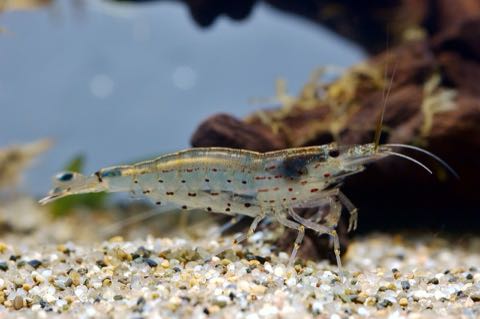 Amano shrimp
- American flagfish
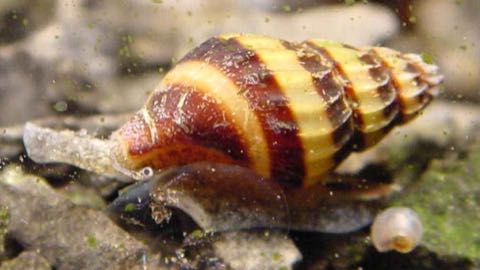 Assassin snail
- Banded gourami
- Bandit cory
- Banjo catfish
- Black phantom tetra
- Black ruby barb
- Blood parrot cichlid
- Bloodfin tetra
Avoid with
- Acei cichlid
No shared pH rangeNo shared pH range
- Black kuhli loach
No shared temperature rangeNo shared temperature range
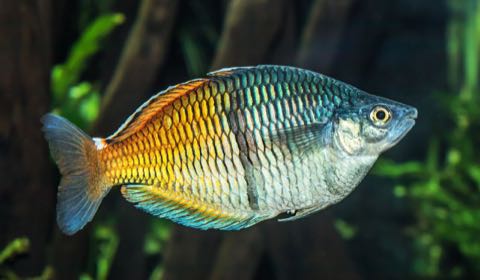 Boeseman rainbowfish
No shared temperature rangeNo shared temperature range
- Brevis shell dweller
No shared pH rangeNo shared pH range
- Caudopunctatus
No shared pH rangeNo shared pH range
- Irian Jaya rainbowfish
No shared temperature rangeNo shared temperature range
- Julii cory
No shared temperature rangeNo shared temperature range
- Multies
No shared pH rangeNo shared pH range
- Parkinson's rainbowfish
No shared temperature rangeNo shared temperature range
- Pindani
No shared pH rangeNo shared pH range
- Rusty cichlid
No shared pH rangeNo shared pH range
- Saulosi cichlid
No shared pH rangeNo shared pH range
Breeding blue acaras
Blue acaras lay eggs on a substrate, and both parents guard the eggs and larvae. Before spawning, a pair cleans a selected rock or broad plant leaf. A dedicated breeding setup avoids exposing companions to parental breeding aggression.Blue acaras lay eggs on a substrate, and both parents guard the eggs and larvae. Before spawning, a pair cleans a selected rock or broad plant leaf. A dedicated breeding setup avoids exposing companions to parental breeding aggression.[1][5][2]
Once a pair forms, remove other acaras unless the tank is very large. Supply flat stones or broad leaves, and switch to air-powered filtration to keep fry from being sucked into power filters.Once a pair forms, remove other acaras unless the tank is very large. Supply flat stones or broad leaves, and switch to air-powered filtration to keep fry from being sucked into power filters.[1]
Eggs hatch in roughly 48–72 hours, and fry swim freely about another 72 hours later. Offer microworm or brine shrimp nauplii to the fry once they are free-swimming.Eggs hatch in roughly 48–72 hours, and fry swim freely about another 72 hours later. Offer microworm or brine shrimp nauplii to the fry once they are free-swimming.[1]
Blue acara health problems
Ich is caused by Ichthyophthirius multifiliis. Salt-like white spots, rubbing, reduced appetite, and rapid breathing can suggest infection, though spots alone cannot confirm a diagnosis. Reduce the risk of introducing ich by quarantining incoming fish for at least 30 days and using dedicated or disinfected nets and siphons. Seek fish-health advice promptly for suspected illness.Ich is caused by Ichthyophthirius multifiliis. Salt-like white spots, rubbing, reduced appetite, and rapid breathing can suggest infection, though spots alone cannot confirm a diagnosis. Reduce the risk of introducing ich by quarantining incoming fish for at least 30 days and using dedicated or disinfected nets and siphons. Seek fish-health advice promptly for suspected illness.[3]
Fin rot is a bacterial problem associated with poor conditions and stress. Fins may fray, develop red blood streaks, and progressively shrink. Check water parameters and address injuries or harassment, seeking fish-health advice if fin condition deteriorates.Fin rot is a bacterial problem associated with poor conditions and stress. Fins may fray, develop red blood streaks, and progressively shrink. Check water parameters and address injuries or harassment, seeking fish-health advice if fin condition deteriorates.[4]
Fungal infection may look like grey-white cottony growth on injured tissue, occurring when injury or poor environmental conditions weaken protective mucus. Use smooth furnishings, gentle handling, and good water quality to reduce risk, and seek prompt advice if symptoms appear.Fungal infection may look like grey-white cottony growth on injured tissue, occurring when injury or poor environmental conditions weaken protective mucus. Use smooth furnishings, gentle handling, and good water quality to reduce risk, and seek prompt advice if symptoms appear.[4]
Male or female?
Sexing blue acaras relies on relative visual differences in adult fish. Mature males are reported to be larger, more colourful, and develop somewhat pointed dorsal and anal fins. Mature females tend to show a rounder body shape.Sexing blue acaras relies on relative visual differences in adult fish. Mature males are reported to be larger, more colourful, and develop somewhat pointed dorsal and anal fins. Mature females tend to show a rounder body shape.[1][5]
Questions
How many blue acara should I keep together?
Blue acaras are typically kept singly or in pairs, as there is no established shoaling requirement. Once a pair forms, other acaras should be removed unless the tank is very large.Blue acaras are typically kept singly or in pairs, as there is no established shoaling requirement. Once a pair forms, other acaras should be removed unless the tank is very large.[2][1]
Will blue acara eat guppies?
Blue acaras can eat fish small enough to swallow. Small guppies carry predation risk and should not be considered safe companions in the same aquarium.Blue acaras can eat fish small enough to swallow. Small guppies carry predation risk and should not be considered safe companions in the same aquarium.[1]
How big do blue acaras get?
Blue acaras reach an adult length of about 15 cm standard length, with maximum sizes recorded up to 16 cm total length.Blue acaras reach an adult length of about 6 in standard length, with maximum sizes recorded up to 6 in total length.[1][5]
Are blue acara cichlids aggressive?
The blue acara is relatively peaceful for an American cichlid of its size. However, other tank mates must be too large to swallow, and companions may face breeding aggression from a bonded pair.The blue acara is relatively peaceful for an American cichlid of its size. However, other tank mates must be too large to swallow, and companions may face breeding aggression from a bonded pair.[1][2]
What fish can I put with blue acara?
Tank mates must be too large to swallow. Medium characins like Congo tetras and black skirt tetras, or bottom dwellers like bronze corydoras and bristlenose plecos, may be considered if their individual space, social, and water needs are fully met.Tank mates must be too large to swallow. Medium characins like Congo tetras and black skirt tetras, or bottom dwellers like bronze corydoras and bristlenose plecos, may be considered if their individual space, social, and water needs are fully met.[1]
Sources
- Andinoacara pulcher (Blue Acara) — Seriously Fish. Accessed 2026-10-05.
- How to look after American cichlids — OATA. Accessed 2026-10-05.
- Ichthyophthirius multifiliis (White Spot) Infections in Fish — UF/IFAS Extension. Accessed 2026-10-05.
- Frequently asked questions on treating sick fish — Practical Fishkeeping. Accessed 2026-10-05.
- Andinoacara pulcher, Blue acara — FishBase. Accessed 2026-10-05.
- Electric blues — Practical Fishkeeping. Accessed 2026-10-05.
Written from the sources above. Not yet reviewed by an aquarist.
Data used by the planner
| Temperature range | 20–24 | AqAdvisor (aqadvisor.com), retrieved 2026-10-04; agrees with FishBase (fishbase.se), retrieved 2026-10-04 · medium confidence |
|---|---|---|
| pH | 6–7.5 | AqAdvisor (aqadvisor.com), retrieved 2026-10-04; agrees with FishBase (fishbase.se), retrieved 2026-10-04 · medium confidence |
| Hardness (dGH) | 1–25 | AqAdvisor (aqadvisor.com), retrieved 2026-10-04 · medium confidence |
| Origin | Trinidad, northern Venezuela and Colombia | curated-v0 (needs expert review) · low confidence |
| Beginner friendly | Yes | curated-v0 (needs expert review) · medium confidence |
| Care level | easy | curated-v0 (needs expert review) · medium confidence |
| Activity | moderate | curated-v0 (needs expert review) · medium confidence |
| Swimming level | middle | curated-v0 (needs expert review) · medium confidence |
| Temperament | semi aggressive | curated-v0 (needs expert review) · medium confidence |
| Nips fins | No | curated-v0 (needs expert review) · medium confidence |
| Long fins | No | curated-v0 (needs expert review) · medium confidence |
| Territorial | Yes | curated-v0 (needs expert review) · medium confidence |
| Lives in groups | No | curated-v0 (needs expert review) · medium confidence |
| Minimum group | 1 | curated-v0 (needs expert review) · medium confidence |
| Diet | omnivore | curated-v0 (needs expert review) · medium confidence |
| Lifespan (years) | 8–10 | curated-v0 (needs expert review) · low confidence |
| Months to adult size | 12 | curated-v0 (needs expert review) · low confidence |
| Safe with plants | Yes | curated-v0 (needs expert review) · medium confidence |
| Minimum tank length | 100 | curated-v0 (needs expert review) · medium confidence |