Neon green rasbora tank size
Provide an aquarium footprint of at least 60 cm × 30 cm. This footprint leaves open swimming routes within a planted layout, which exceeds basic size calculations for a fish with an adult length of about 2 cm.Provide an aquarium footprint of at least 24 in × 12 in. This footprint leaves open swimming routes within a planted layout, which exceeds basic size calculations for a fish with an adult length of about 1 in.[1]
Add this sensitive small fish to a mature, stable aquarium rather than a newly set-up system. Use dense planting and a dark substrate, and add driftwood with attached Java fern or Anubias to provide cover while keeping swimming routes open.Add this sensitive small fish to a mature, stable aquarium rather than a newly set-up system. Use dense planting and a dark substrate, and add driftwood with attached Java fern or Anubias to provide cover while keeping swimming routes open.[1]
Neon green rasbora water parameters
Maintain shared water conditions of 23–27 °C, pH 6.5–7.0, and GH 5–10. These ranges represent the overlap of general aquarium parameters and narrower species data.Maintain shared water conditions of 73–81 °F, pH 6.5–7.0, and GH 5–10. These ranges represent the overlap of general aquarium parameters and narrower species data.[1]
Keep water clean and well-oxygenated with gentle to moderate movement, avoiding strong currents that pin the fish in place. Conduct regular weekly partial water changes, matching replacement water to prevent abrupt temperature or chemistry changes.Keep water clean and well-oxygenated with gentle to moderate movement, avoiding strong currents that pin the fish in place. Conduct regular weekly partial water changes, matching replacement water to prevent abrupt temperature or chemistry changes.[1]
Use a mature biological filter to process fish waste and keep ammonia undetectable. Overfeeding and impaired filtration can raise ammonia, causing tissue damage and greater vulnerability to infection. Test ammonia regularly and immediately if fish stop feeding or behave abnormally.Use a mature biological filter to process fish waste and keep ammonia undetectable. Overfeeding and impaired filtration can raise ammonia, causing tissue damage and greater vulnerability to infection. Test ammonia regularly and immediately if fish stop feeding or behave abnormally.[3]
Feeding neon green rasboras
Offer tiny live or frozen Daphnia and Artemia alongside suitably sized dry food, because their small mouth limits food size. Crush oversized flakes so the fish can swallow them, and rotate dry food with small live or frozen items.Offer tiny live or frozen Daphnia and Artemia alongside suitably sized dry food, because their small mouth limits food size. Crush oversized flakes so the fish can swallow them, and rotate dry food with small live or frozen items.[1]
Use a starting routine of two small meals daily, feeding portions eaten in about two minutes. Adjust amounts to fish size, and remove uneaten food so decomposing waste does not raise ammonia levels.Use a starting routine of two small meals daily, feeding portions eaten in about two minutes. Adjust amounts to fish size, and remove uneaten food so decomposing waste does not raise ammonia levels.[2][3]
Neon green rasbora behaviour
Keep at least eight fish, with eight to ten or more providing a better starting shoal. Keeping them in groups maintains their confidence, whereas isolated fish are likely to be less confident.Keep at least eight fish, with eight to ten or more providing a better starting shoal. Keeping them in groups maintains their confidence, whereas isolated fish are likely to be less confident.[1]
This species is a peaceful small shoaler with an adult length of about 2 cm, whose males may display more strongly during courtship. The intense yellow-green colour belongs naturally to the species rather than being an artificial fluorescent variety.This species is a peaceful small shoaler with an adult length of about 1 in, whose males may display more strongly during courtship. The intense yellow-green colour belongs naturally to the species rather than being an artificial fluorescent variety.[1]
Green neon rasbora, yellow neon rasbora, and Kubotai rasbora are trade names for Microdevario kubotai, not separate varieties. An aquarium lifespan of three to seven years is reported as a hobby estimate, although the upper end remains uncertain.Green neon rasbora, yellow neon rasbora, and Kubotai rasbora are trade names for Microdevario kubotai, not separate varieties. An aquarium lifespan of three to seven years is reported as a hobby estimate, although the upper end remains uncertain.[1][6]
Neon green rasbora tank mates
Harlequin rasborasHarlequin rasboras are a named cyprinid companion, provided the aquarium fits both shoals and has suitable shared water. Avoid boisterous or substantially larger fish. are a named cyprinid companion, provided the aquarium fits both shoals and has suitable shared water. Avoid boisterous or substantially larger fish.[1]
Lambchop rasborasLambchop rasboras are another option, though a narrow shared pH overlap requires establishing a stable shared pH before housing them together. are another option, though a narrow shared pH overlap requires establishing a stable shared pH before housing them together. Kuhli loachesKuhli loaches can live on the bottom if you provide their own group, soft substrate, and retreats. can live on the bottom if you provide their own group, soft substrate, and retreats.[1]
Adult Adult cherry shrimpcherry shrimp can share a densely planted tank when water parameters suit both species. However, adult rasboras can eat tiny shrimplets, so this combination is not safe for breeding shrimp. can share a densely planted tank when water parameters suit both species. However, adult rasboras can eat tiny shrimplets, so this combination is not safe for breeding shrimp.[6]
Avoid large or aggressive companions in the tank. Avoid Avoid large or aggressive companions in the tank. Avoid oscarsoscars, which can swallow tiny rasboras whole. Avoid , which can swallow tiny rasboras whole. Avoid Jack DempseysJack Dempseys due to their territorial behaviour and adult size, and avoid due to their territorial behaviour and adult size, and avoid pea pufferspea puffers because fin nipping and aggression threaten this peaceful shoal. because fin nipping and aggression threaten this peaceful shoal.[1][7][8][9]
Usually fine together
- African butterfly cichlid
- Agassiz's cory
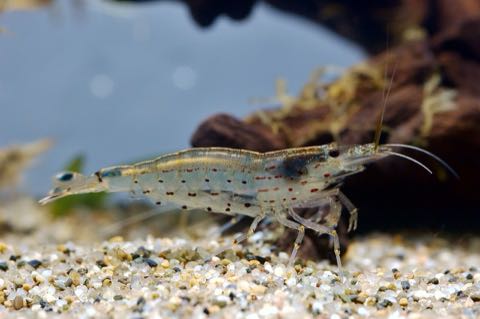 Amano shrimp
- American flagfish
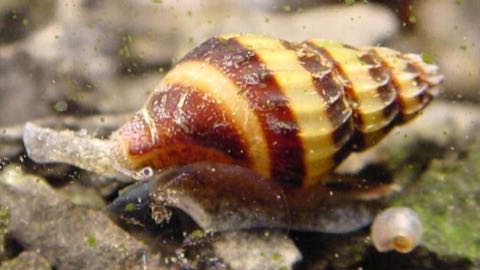 Assassin snail
- Banded gourami
- Bandit cory
- Banjo catfish
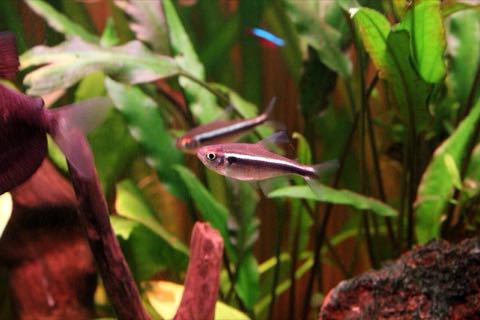 Black neon tetra
- Black phantom tetra
- Black ruby barb
- Blackline rasbora
Avoid with
- Acei cichlid
No shared pH rangeNo shared pH range
- African clawed frog
African clawed frog may eat Kubotai rasboraAfrican clawed frog may eat Kubotai rasbora
- Brevis shell dweller
No shared pH rangeNo shared pH range
- Caudopunctatus
No shared pH rangeNo shared pH range
- Multies
No shared pH rangeNo shared pH range
- Pindani
No shared pH rangeNo shared pH range
- Rusty cichlid
No shared pH rangeNo shared pH range
- Saulosi cichlid
No shared pH rangeNo shared pH range
- Similis shell dweller
No shared pH rangeNo shared pH range
- Abei puffer
Abei puffer may eat Kubotai rasboraAbei puffer may eat Kubotai rasbora
- Afra cichlid
No shared pH rangeNo shared pH range
- African butterflyfish
African butterflyfish may eat Kubotai rasboraAfrican butterflyfish may eat Kubotai rasbora
Breeding neon green rasboras
This species scatters eggs among plants or spawning mops and provides no parental care. Adults may eat their own eggs if left in the breeding area.This species scatters eggs among plants or spawning mops and provides no parental care. Adults may eat their own eggs if left in the breeding area.[1]
For a deliberate breeding attempt, use a separate mature planted container with gentle filtration. Remove the adult fish after two or three days so they do not eat the eggs.For a deliberate breeding attempt, use a separate mature planted container with gentle filtration. Remove the adult fish after two or three days so they do not eat the eggs.[1]
Eggs can hatch in about 72 hours, and fry become free-swimming three to four days later, with timing influenced by water temperature. Newly free-swimming fry require microscopic first foods before they can accept baby Artemia or microworms.Eggs can hatch in about 72 hours, and fry become free-swimming three to four days later, with timing influenced by water temperature. Newly free-swimming fry require microscopic first foods before they can accept baby Artemia or microworms.[1]
Neon green rasbora health problems
Ich is a parasitic infection causing white spots, rubbing, clamped fins, and laboured breathing, though some gill infections show no obvious body spots. Because ich can arrive on fish or wet equipment, quarantine new fish for at least 30 days and avoid sharing uncleaned nets between tanks.Ich is a parasitic infection causing white spots, rubbing, clamped fins, and laboured breathing, though some gill infections show no obvious body spots. Because ich can arrive on fish or wet equipment, quarantine new fish for at least 30 days and avoid sharing uncleaned nets between tanks.[5]
Fin rot is a bacterial problem associated with poor water conditions, marked by shrinking fins, persistent fraying, and blood-streaked edges. Reduce fin-rot risk by maintaining water quality and removing harassment or injury sources, evaluating progressive damage promptly rather than assuming every tear is an active infection.Fin rot is a bacterial problem associated with poor water conditions, marked by shrinking fins, persistent fraying, and blood-streaked edges. Reduce fin-rot risk by maintaining water quality and removing harassment or injury sources, evaluating progressive damage promptly rather than assuming every tear is an active infection.[4]
Fungal cotton-wool disease produces fluffy white or grey growth on damaged tissue after physical injury and environmental stress allow fungi to settle. Prevent fungal problems by avoiding sharp decor, avoiding rough handling, and correcting poor water conditions, seeking prompt diagnosis because mouth rot can resemble fungus.Fungal cotton-wool disease produces fluffy white or grey growth on damaged tissue after physical injury and environmental stress allow fungi to settle. Prevent fungal problems by avoiding sharp decor, avoiding rough handling, and correcting poor water conditions, seeking prompt diagnosis because mouth rot can resemble fungus.[4]
Male or female?
Mature females tend to be larger and deeper-bodied than males. Mature males are slimmer and can show stronger colour during courtship displays. Young fish are difficult to sex with confidence.Mature females tend to be larger and deeper-bodied than males. Mature males are slimmer and can show stronger colour during courtship displays. Young fish are difficult to sex with confidence.[1]
Questions
How big do neon green rasboras get?
Adult standard length for Microdevario kubotai is about 2 cm.Adult standard length for Microdevario kubotai is about 1 in.[1]
How many neon green rasboras should be kept together?
Keep at least eight fish, with eight to ten or more providing a better starting shoal that prevents isolated fish from feeling less confident.Keep at least eight fish, with eight to ten or more providing a better starting shoal that prevents isolated fish from feeling less confident.[1]
Are green rasboras aggressive?
No, this is a peaceful small shoaler, though males may display more strongly during courtship. Keep them away from boisterous or substantially larger tank mates.No, this is a peaceful small shoaler, though males may display more strongly during courtship. Keep them away from boisterous or substantially larger tank mates.[1]
Do rasboras like heavily planted tanks?
Yes. Dense planting and dark substrate provide cover, and driftwood with Java fern or Anubias leaves clear routes for the shoal.Yes. Dense planting and dark substrate provide cover, and driftwood with Java fern or Anubias leaves clear routes for the shoal.[1]
How often do rasboras need to be fed?
A practical routine is two small meals daily, offering food portions eaten in about two minutes and removing leftovers.A practical routine is two small meals daily, offering food portions eaten in about two minutes and removing leftovers.[2]
Are neon green rasboras hard to keep?
They are sensitive fish that require a mature, stable aquarium with gentle water flow and water kept at 23–27 °C and pH 6.5–7.0.They are sensitive fish that require a mature, stable aquarium with gentle water flow and water kept at 73–81 °F and pH 6.5–7.0.[1]
How do you breed green neon rasboras?
Spawn them in a separate mature planted tank, remove adults after two or three days, and give newly free-swimming fry microscopic first foods.Spawn them in a separate mature planted tank, remove adults after two or three days, and give newly free-swimming fry microscopic first foods.[1]
Sources
- Microdevario kubotai — Seriously Fish. Accessed 2026-10-05.
- What to feed your fish — RSPCA. Accessed 2026-10-05.
- Ammonia in Aquatic Systems — UF/IFAS Extension. Accessed 2026-10-05.
- Frequently asked questions on treating sick fish — Practical Fishkeeping. Accessed 2026-10-05.
- Ichthyophthirius multifiliis (White Spot) Infections in Fish — UF/IFAS Extension. Accessed 2026-10-05.
- Neon Green Rasbora (Microdevario kubotai): Care & Lifespan — Fish Laboratory. Accessed 2026-10-05.
- Astronotus ocellatus (Oscar) — Seriously Fish. Accessed 2026-10-05.
- Rocio octofasciata (Jack Dempsey) — Seriously Fish. Accessed 2026-10-05.
- Carinotetraodon travancoricus (Dwarf Puffer) — Seriously Fish. Accessed 2026-10-05.
Written from the sources above. Not yet reviewed by an aquarist.
Data used by the planner
| Temperature | 23–28 | AqAdvisor (aqadvisor.com), retrieved 2026-10-04 · medium confidence |
|---|---|---|
| pH | 6.5–7.5 | AqAdvisor (aqadvisor.com), retrieved 2026-10-04 · medium confidence |
| Hardness (dGH) | 5–15 | AqAdvisor (aqadvisor.com), retrieved 2026-10-04 · medium confidence |
| Origin | Southern Myanmar and western Thailand | curated-v0 (needs expert review) · low confidence |
| Beginner friendly | Yes | curated-v0 (needs expert review) · medium confidence |
| Care level | easy | curated-v0 (needs expert review) · medium confidence |
| Activity | active | curated-v0 (needs expert review) · medium confidence |
| Swimming level | middle | curated-v0 (needs expert review) · medium confidence |
| Temperament | peaceful | curated-v0 (needs expert review) · medium confidence |
| Nips fins | No | curated-v0 (needs expert review) · medium confidence |
| Long fins | No | curated-v0 (needs expert review) · medium confidence |
| Territorial | No | curated-v0 (needs expert review) · medium confidence |
| Lives in groups | Yes | curated-v0 (needs expert review) · medium confidence |
| Minimum group | 8 | curated-v0 (needs expert review) · medium confidence |
| Diet | omnivore | curated-v0 (needs expert review) · medium confidence |
| Lifespan (years) | 3–5 | curated-v0 (needs expert review) · low confidence |
| Months to adult size | 6 | curated-v0 (needs expert review) · low confidence |
| Safe with plants | Yes | curated-v0 (needs expert review) · medium confidence |