Pearl danio tank size
Provide a tank base at least 90 cm long and 30 cm wide for this active species. The reported adult standard length for the pearl danio is 5.5 cm.Provide a tank base at least 35 in long and 12 in wide for this active species. The reported adult standard length for the pearl danio is 2.2 in.[1]
Use a tightly fitted cover on the aquarium because these fish can jump through small gaps. Darker substrate and live plants suit the species, whereas sparse decoration may leave their colours paler.Use a tightly fitted cover on the aquarium because these fish can jump through small gaps. Darker substrate and live plants suit the species, whereas sparse decoration may leave their colours paler.[1]
Roots, branches and attached Microsorum, Bolbitis or Anubias can be used in the aquarium layout. Provide moderate flow, but avoid torrent-like conditions because small danionins use calmer margins in nature.Roots, branches and attached Microsorum, Bolbitis or Anubias can be used in the aquarium layout. Provide moderate flow, but avoid torrent-like conditions because small danionins use calmer margins in nature.[1]
The species is reported from Myanmar, Indochina, Peninsular Malaysia and Sumatra in habitats ranging from streams to ponds and rice paddies. In these natural habitats, small danionins stay in calmer margins away from heavy torrents.The species is reported from Myanmar, Indochina, Peninsular Malaysia and Sumatra in habitats ranging from streams to ponds and rice paddies. In these natural habitats, small danionins stay in calmer margins away from heavy torrents.[1]
Pearl danio water parameters
Use water targets of 18–24 °C, pH 6.0–8.0 and 5–15 dGH, which fall within the species profile ranges.Use water targets of 64–75 °F, pH 6.0–8.0 and 5–15 dGH, which fall within the species profile ranges.[1]
Test water weekly; ammonia and nitrite should be zero. Replace about one quarter of the water weekly using conditioned replacement water.Test water weekly; ammonia and nitrite should be zero. Replace about one quarter of the water weekly using conditioned replacement water.[2]
Rinse filter media lightly in removed aquarium water during maintenance. Untreated tap disinfectants may harm bacteria living on the media.Rinse filter media lightly in removed aquarium water during maintenance. Untreated tap disinfectants may harm bacteria living on the media.[2]
Feeding pearl danios
Feed pearl danios once a day, offering only what the fish consume within a few minutes. Uneaten food decomposes into waste, so avoid overfeeding.Feed pearl danios once a day, offering only what the fish consume within a few minutes. Uneaten food decomposes into waste, so avoid overfeeding.[2]
Feed good-quality flake or granules as staple food. Supplement dried food with small live or frozen bloodworm, daphnia and Artemia.Feed good-quality flake or granules as staple food. Supplement dried food with small live or frozen bloodworm, daphnia and Artemia.[1]
Pearl danio behaviour
Keep a group of at least eight pearl danios; eight to ten or more are recommended. Larger groups can make them less nervous in the aquarium.Keep a group of at least eight pearl danios; eight to ten or more are recommended. Larger groups can make them less nervous in the aquarium.[1]
Pearl danios are described as very peaceful, but you should research companions and consider their small adult size. Adult standard length is reported at 5.5 cm.Pearl danios are described as very peaceful, but you should research companions and consider their small adult size. Adult standard length is reported at 2.2 in.[1]
Colours vary between localities: western Thai examples can have an orange upper body, while central Thai examples have blue there, and orange stripe shape varies too. Some traded fish may be hybrids with Brachydanio rosea.Colours vary between localities: western Thai examples can have an orange upper body, while central Thai examples have blue there, and orange stripe shape varies too. Some traded fish may be hybrids with Brachydanio rosea.[1]
Pearl danio tank mates
Neon tetrasNeon tetras and and X-ray tetrasX-ray tetras are conditional examples of suitable tetras. Match water, provide appropriate space and maintain separate schools for each species. are conditional examples of suitable tetras. Match water, provide appropriate space and maintain separate schools for each species.[1]
Bronze corydorasBronze corydoras can work as companions if you match water and provide their own group, bottom area and food. can work as companions if you match water and provide their own group, bottom area and food. Bristlenose plecosBristlenose plecos can also work if you plan adult space and feed them separately. can also work if you plan adult space and feed them separately.[1]
Avoid Avoid oscarsoscars, as much smaller fish may be eaten by these predators. Also avoid , as much smaller fish may be eaten by these predators. Also avoid Jack DempseysJack Dempseys; adult aggression and their need for companions too large to be prey make them unsuitable.; adult aggression and their need for companions too large to be prey make them unsuitable.[5][6]
Keep Keep pea pufferspea puffers separate. General community keeping is discouraged for them, and vigorous fish may outcompete them for food. separate. General community keeping is discouraged for them, and vigorous fish may outcompete them for food.[7]
Usually fine together
- African clawed frog
- Agassiz's cory
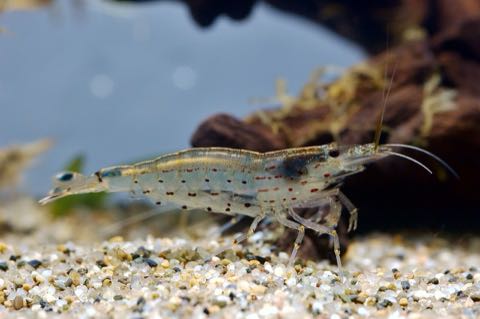 Amano shrimp
- American flagfish
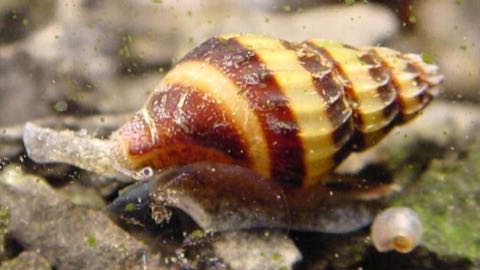 Assassin snail
- Banded gourami
- Bandit cory
- Banjo catfish
- Black phantom tetra
- Black ruby barb
- Blood parrot cichlid
- Bloodfin tetra
Avoid with
- Black kuhli loach
No shared temperature rangeNo shared temperature range
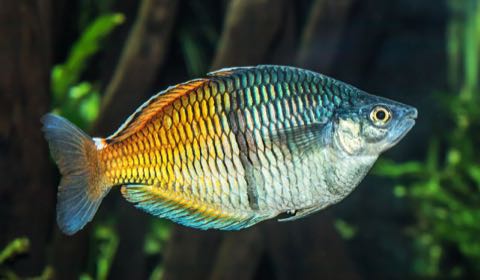 Boeseman rainbowfish
No shared temperature rangeNo shared temperature range
- Irian Jaya rainbowfish
No shared temperature rangeNo shared temperature range
- Julii cory
No shared temperature rangeNo shared temperature range
- Parkinson's rainbowfish
No shared temperature rangeNo shared temperature range
- Rusty cichlid
No shared temperature rangeNo shared temperature range
- Afra cichlid
No shared temperature rangeNo shared temperature range
- African knifefish
African knifefish may eat Pearl danioAfrican knifefish may eat Pearl danio
- African pike
No shared temperature rangeNo shared temperature range
- Alligator gar
Alligator gar may eat Pearl danioAlligator gar may eat Pearl danio
- Altum angelfish
No shared temperature rangeNo shared temperature range
- Antenna ray
Antenna ray may eat Pearl danioAntenna ray may eat Pearl danio
Breeding pearl danios
Pearl danios scatter eggs and show no parental care. Some fry may appear in a mature densely planted aquarium without intervention.Pearl danios scatter eggs and show no parental care. Some fry may appear in a mature densely planted aquarium without intervention.[1]
Adults eat eggs they find. A separate spawning setup with egg-protecting mesh or fine-leaved plants and later mature sponge filtration can increase fry yield.Adults eat eggs they find. A separate spawning setup with egg-protecting mesh or fine-leaved plants and later mature sponge filtration can increase fry yield.[1]
Pearl danio health problems
Ich is a protozoan infection that can cause salt-like spots, rubbing, reduced appetite and gill irritation. Microscopy confirms diagnosis. Quarantine new fish for 30 days and disinfect or separate equipment to reduce introduction risk.Ich is a protozoan infection that can cause salt-like spots, rubbing, reduced appetite and gill irritation. Microscopy confirms diagnosis. Quarantine new fish for 30 days and disinfect or separate equipment to reduce introduction risk.[3]
Fin rot can cause fraying, red streaks and progressive fin loss. Poor conditions and stress encourage bacterial disease. Good water quality and addressing harassment reduce relevant risks; seek advice for worsening fins.Fin rot can cause fraying, red streaks and progressive fin loss. Poor conditions and stress encourage bacterial disease. Good water quality and addressing harassment reduce relevant risks; seek advice for worsening fins.[4]
Fungal infection may look like grey-white cotton on damaged skin. Injury and environmental stress impair protective mucus. Gentle handling and smooth furnishings reduce injury risk, while good water quality reduces environmental stress.Fungal infection may look like grey-white cotton on damaged skin. Injury and environmental stress impair protective mucus. Gentle handling and smooth furnishings reduce injury risk, while good water quality reduces environmental stress.[4]
Male or female?
Mature females tend to be rounder-bellied, slightly larger and less colourful than males. These differences stand out particularly when the fish are in spawning condition.Mature females tend to be rounder-bellied, slightly larger and less colourful than males. These differences stand out particularly when the fish are in spawning condition.[1]
Questions
How many danios should be kept together?
Keep a group of at least eight pearl danios, though eight to ten or more are recommended. Larger groups can make the fish less nervous.Keep a group of at least eight pearl danios, though eight to ten or more are recommended. Larger groups can make the fish less nervous.[1]
How can you tell if a pearl danio is male or female?
Mature females tend to be slightly larger, rounder-bellied and less colourful than males. These physical differences stand out when they enter spawning condition.Mature females tend to be slightly larger, rounder-bellied and less colourful than males. These physical differences stand out when they enter spawning condition.[1]
What fish pair well with danios?
Neon tetrasNeon tetras and and X-ray tetrasX-ray tetras can work if you match water, provide space and keep separate schools. can work if you match water, provide space and keep separate schools. Bronze corydorasBronze corydoras can work if you match water and provide their own group, bottom area and food. can work if you match water and provide their own group, bottom area and food.[1]
Do danios reproduce easily?
Pearl danios scatter eggs without parental care, and some fry may appear in a mature densely planted aquarium. However, adults eat eggs they find, so a separate setup with protective mesh or fine-leaved plants can increase fry yield.Pearl danios scatter eggs without parental care, and some fry may appear in a mature densely planted aquarium. However, adults eat eggs they find, so a separate setup with protective mesh or fine-leaved plants can increase fry yield.[1]
What should pearl danios eat?
Feed good-quality flake or granules as staple food once a day, offering only what they consume within a few minutes. Supplement dried food with small live or frozen bloodworm, daphnia and Artemia.Feed good-quality flake or granules as staple food once a day, offering only what they consume within a few minutes. Supplement dried food with small live or frozen bloodworm, daphnia and Artemia.[1][2]
Sources
- Brachydanio albolineata (Pearl 'Danio') — Seriously Fish. Accessed 2026-10-05.
- How to look after danios and white cloud mountain minnows — Ornamental Aquatic Trade Association. Accessed 2026-10-05.
- Ichthyophthirius multifiliis (White Spot) Infections in Fish — UF/IFAS Extension. Accessed 2026-10-05.
- Frequently asked questions on treating sick fish — Practical Fishkeeping. Accessed 2026-10-05.
- Astronotus ocellatus (Oscar) — Seriously Fish. Accessed 2026-10-05.
- Rocio octofasciata (Jack Dempsey) — Seriously Fish. Accessed 2026-10-05.
- Carinotetraodon travancoricus (Dwarf Puffer) — Seriously Fish. Accessed 2026-10-05.
Written from the sources above. Not yet reviewed by an aquarist.
Data used by the planner
| Temperature | 18–24 | AqAdvisor (aqadvisor.com), retrieved 2026-10-04; agrees with FishBase (fishbase.se), retrieved 2026-10-04 · medium confidence |
|---|---|---|
| pH | 6–8 | AqAdvisor (aqadvisor.com), retrieved 2026-10-04; agrees with FishBase (fishbase.se), retrieved 2026-10-04 · medium confidence |
| Hardness (dGH) | 5–15 | AqAdvisor (aqadvisor.com), retrieved 2026-10-04 · low confidence |
| Origin | Myanmar, Thailand, Laos, Malaysia and Sumatra | curated-v0 (needs expert review) · low confidence |
| Beginner friendly | Yes | curated-v0 (needs expert review) · medium confidence |
| Care level | easy | curated-v0 (needs expert review) · medium confidence |
| Activity | active | curated-v0 (needs expert review) · medium confidence |
| Swimming level | top | curated-v0 (needs expert review) · medium confidence |
| Temperament | peaceful | curated-v0 (needs expert review) · medium confidence |
| Nips fins | No | curated-v0 (needs expert review) · medium confidence |
| Long fins | No | curated-v0 (needs expert review) · medium confidence |
| Territorial | No | curated-v0 (needs expert review) · medium confidence |
| Lives in groups | Yes | curated-v0 (needs expert review) · medium confidence |
| Minimum group | 6 | curated-v0 (needs expert review) · medium confidence |
| Diet | omnivore | curated-v0 (needs expert review) · medium confidence |
| Lifespan (years) | 3–5 | curated-v0 (needs expert review) · low confidence |
| Months to adult size | 8 | curated-v0 (needs expert review) · low confidence |
| Safe with plants | Yes | curated-v0 (needs expert review) · medium confidence |