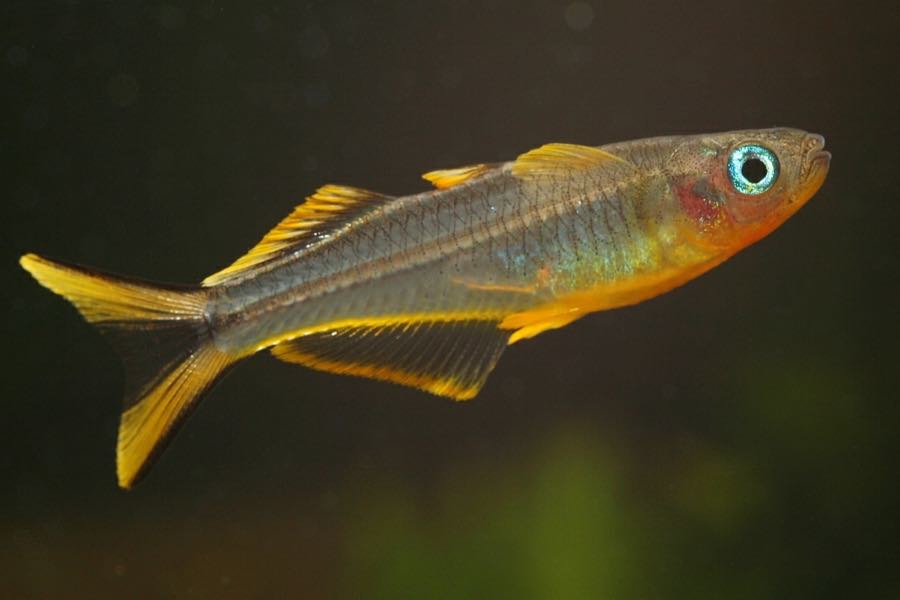
Forktail blue-eye tank size
Provide an aquarium with a minimum tank length of 60 cm to house a shoal of forktail blue-eyes. A spacious base width allows enough surface room and horizontal swimming space for their darting movements, making this tank length the smallest practical starting point. While individuals can reach an adult length of 6 cm standard length, their active swimming style demands substantial swimming room.Provide an aquarium with a minimum tank length of 24 in to house a shoal of forktail blue-eyes. A spacious base width allows enough surface room and horizontal swimming space for their darting movements, making this tank length the smallest practical starting point. While individuals can reach an adult length of 2 in standard length, their active swimming style demands substantial swimming room.[1]
In the wild, these fish inhabit clear, heavily vegetated forest streams with slow to moderate flow across Northern and Milne Bay provinces in eastern Papua New Guinea. Replicate these natural conditions by using dense aquatic plants, floating plants, and driftwood roots or branches to diffuse harsh overhead lighting. Arrange your hardscape and vegetation around the perimeter so the fish retain open swimming areas alongside protective cover.In the wild, these fish inhabit clear, heavily vegetated forest streams with slow to moderate flow across Northern and Milne Bay provinces in eastern Papua New Guinea. Replicate these natural conditions by using dense aquatic plants, floating plants, and driftwood roots or branches to diffuse harsh overhead lighting. Arrange your hardscape and vegetation around the perimeter so the fish retain open swimming areas alongside protective cover.[1]
Forktail blue-eye water parameters
House this species only in a mature aquarium with stable biological filtration, consistent water circulation, and well-oxygenated water. Forktail blue-eyes are sensitive to rapid swings in water chemistry, so you must avoid introducing them to freshly set up setups with unstable parameters.House this species only in a mature aquarium with stable biological filtration, consistent water circulation, and well-oxygenated water. Forktail blue-eyes are sensitive to rapid swings in water chemistry, so you must avoid introducing them to freshly set up setups with unstable parameters.[1]
Maintain your water temperature between 24–28 °C and keep the pH between 7–8. Regarding general hardness, the primary species reference advises a harder range of 15–30 dGH, whereas general captive records suggest 5–15 dGH; their direct intersection is 15 dGH.Maintain your water temperature between 75–82 °F and keep the pH between 7–8. Regarding general hardness, the primary species reference advises a harder range of 15–30 dGH, whereas general captive records suggest 5–15 dGH; their direct intersection is 15 dGH.[1]
Feeding forktail blue-eyes
Wild forktail blue-eyes feed naturally on floating or suspended plankton and small invertebrates. In home aquariums, feed them small live items such as Daphnia, Moina, Artemia nauplii, and microworm, paired with finely crushed floating dried flakes or pellets.Wild forktail blue-eyes feed naturally on floating or suspended plankton and small invertebrates. In home aquariums, feed them small live items such as Daphnia, Moina, Artemia nauplii, and microworm, paired with finely crushed floating dried flakes or pellets.[1]
Feed two or three small meals daily, offering only the portion your fish can finish within 2–5 minutes. Adjust the total quantity to match the size and headcount of your group, and remove uneaten leftovers promptly to stop organic waste from decaying in the water.Feed two or three small meals daily, offering only the portion your fish can finish within 2–5 minutes. Adjust the total quantity to match the size and headcount of your group, and remove uneaten leftovers promptly to stop organic waste from decaying in the water.[2]
Forktail blue-eye behaviour
Keep a social group of at least eight forktail blue-eyes, though keeping eight to ten or more is preferable. Living in a substantial group reduces nervousness, and competing for female attention prompts males to display their most vibrant coloration.Keep a social group of at least eight forktail blue-eyes, though keeping eight to ten or more is preferable. Living in a substantial group reduces nervousness, and competing for female attention prompts males to display their most vibrant coloration.[1]
Forktail blue-eyes have a peaceful temperament, making them well suited to community setups featuring tank mates of similar size and water requirements. They are also sold under the trade names forktail rainbowfish and yellow forktail, which represent commercial naming rather than distinct wild colour morphs.Forktail blue-eyes have a peaceful temperament, making them well suited to community setups featuring tank mates of similar size and water requirements. They are also sold under the trade names forktail rainbowfish and yellow forktail, which represent commercial naming rather than distinct wild colour morphs.[1]
Virtually all commercial aquarium stock traces back to an original collection made in 1981, which presents genuine inbreeding issues such as reduced fertility and deformed fry. Pseudomugil species are naturally short-lived; wild females may survive only one reproductive season, though well-maintained aquariums can extend their lifespan past the onset of reduced fertility at 12–18 months.Virtually all commercial aquarium stock traces back to an original collection made in 1981, which presents genuine inbreeding issues such as reduced fertility and deformed fry. Pseudomugil species are naturally short-lived; wild females may survive only one reproductive season, though well-maintained aquariums can extend their lifespan past the onset of reduced fertility at 12–18 months.[1]
Forktail blue-eye tank mates
Peacock gudgeonsPeacock gudgeons occur alongside this species in their native habitat and are appropriate companions when you provide matching water chemistry, sufficient floor space, and routine monitoring. occur alongside this species in their native habitat and are appropriate companions when you provide matching water chemistry, sufficient floor space, and routine monitoring. Dwarf neon rainbowfishDwarf neon rainbowfish can also work if the aquarium provides ample physical swimming room for both active shoals under shared water parameters. can also work if the aquarium provides ample physical swimming room for both active shoals under shared water parameters.[1]
Calm cyprinids such as Calm cyprinids such as cherry barbscherry barbs and and harlequin rasborasharlequin rasboras make suitable companions provided each species is maintained in its own dedicated group and water parameters overlap neatly. make suitable companions provided each species is maintained in its own dedicated group and water parameters overlap neatly.[1]
Never house forktail blue-eyes with large, predatory cichlids. Both Never house forktail blue-eyes with large, predatory cichlids. Both oscarsoscars and and Jack DempseysJack Dempseys require tank mates far too large to be considered prey, meaning these small blue-eyes would quickly be swallowed. require tank mates far too large to be considered prey, meaning these small blue-eyes would quickly be swallowed.[5][6]
Avoid housing them with Avoid housing them with pea pufferspea puffers. Pea puffers present an ongoing fin-nipping risk to delicate fins, while energetic shoaling fish can easily outcompete the puffer during feeding sessions.. Pea puffers present an ongoing fin-nipping risk to delicate fins, while energetic shoaling fish can easily outcompete the puffer during feeding sessions.[7]
Usually fine together
- African butterfly cichlid
- Agassiz's cory
 Amano shrimp
- American flagfish
 Assassin snail
- Banded gourami
- Bandit cory
- Banjo catfish
 Black neon tetra
- Black phantom tetra
- Black ruby barb
- Blackline rasbora
Avoid with
- African knifefish
African knifefish may eat Forktail blue eyeAfrican knifefish may eat Forktail blue eye
- African pike
African pike may eat Forktail blue eyeAfrican pike may eat Forktail blue eye
- Alligator gar
Alligator gar may eat Forktail blue eyeAlligator gar may eat Forktail blue eye
- Antenna ray
Antenna ray may eat Forktail blue eyeAntenna ray may eat Forktail blue eye
- Arapaima
Arapaima may eat Forktail blue eyeArapaima may eat Forktail blue eye
- Asian arowana
Asian arowana may eat Forktail blue eyeAsian arowana may eat Forktail blue eye
- Asian upside-down catfish
Asian upside down catfish may eat Forktail blue eyeAsian upside down catfish may eat Forktail blue eye
- Australian pearl arowana
Australian pearl arowana may eat Forktail blue eyeAustralian pearl arowana may eat Forktail blue eye
- Barred bichir
Barred bichir may eat Forktail blue eyeBarred bichir may eat Forktail blue eye
- Black bullhead
Black bullhead may eat Forktail blue eyeBlack bullhead may eat Forktail blue eye
- Black diamond cichlid
Black diamond cichlid may eat Forktail blue eyeBlack diamond cichlid may eat Forktail blue eye
- Brown bullhead
Brown bullhead may eat Forktail blue eyeBrown bullhead may eat Forktail blue eye
Breeding forktail blue-eyes
This species is an egg-scatterer that provides no parental care. Adults may consume eggs and fry if left together. Females attach their eggs to aquatic vegetation or spawning mops across successive spawning days.This species is an egg-scatterer that provides no parental care. Adults may consume eggs and fry if left together. Females attach their eggs to aquatic vegetation or spawning mops across successive spawning days.[1]
Set up a separate spawning aquarium equipped with an air-powered sponge filter and spawning mops or fine mosses. Collecting eggs or mops daily into a separate incubation container prevents adult predation.Set up a separate spawning aquarium equipped with an air-powered sponge filter and spawning mops or fine mosses. Collecting eggs or mops daily into a separate incubation container prevents adult predation.[1]
Egg incubation takes about 21 days depending on ambient water temperature. Upon emerging, fry are large enough to accept Artemia nauplii, microworms, or finely powdered dry foods immediately.Egg incubation takes about 21 days depending on ambient water temperature. Upon emerging, fry are large enough to accept Artemia nauplii, microworms, or finely powdered dry foods immediately.[1]
Provide growing fry with small meals at least twice every day. Perform regular, modest water changes and vacuum waste diligently, because accumulated leftover food and stagnant, aged rearing water cause severe fry mortality.Provide growing fry with small meals at least twice every day. Perform regular, modest water changes and vacuum waste diligently, because accumulated leftover food and stagnant, aged rearing water cause severe fry mortality.[1]
Forktail blue-eye health problems
Ich is a freshwater parasite infection. Visible signs can include salt-like white spots scattered across the skin, rubbing against hardscape, decreased feeding appetite, and noticeable gill irritation. Because visual symptoms alone cannot confirm an exact diagnosis, seek qualified aquatic advice promptly whenever these signs appear.Ich is a freshwater parasite infection. Visible signs can include salt-like white spots scattered across the skin, rubbing against hardscape, decreased feeding appetite, and noticeable gill irritation. Because visual symptoms alone cannot confirm an exact diagnosis, seek qualified aquatic advice promptly whenever these signs appear.[3]
Quarantine all incoming fish for at least 30 days before introducing them to your display, and clean or disinfect your nets between tanks. While these biosecurity measures reduce the risk of introducing parasites into your aquarium, they do not completely eliminate the possibility of infection.Quarantine all incoming fish for at least 30 days before introducing them to your display, and clean or disinfect your nets between tanks. While these biosecurity measures reduce the risk of introducing parasites into your aquarium, they do not completely eliminate the possibility of infection.[3]
Fin rot is a bacterial issue encouraged by poor conditions and stress, leading to fraying fins with red streaks and progressive shrinking. Maintain water quality and remove sources of physical injury or harassment to reduce fin-rot risk, and seek assessment if fins deteriorate.Fin rot is a bacterial issue encouraged by poor conditions and stress, leading to fraying fins with red streaks and progressive shrinking. Maintain water quality and remove sources of physical injury or harassment to reduce fin-rot risk, and seek assessment if fins deteriorate.[4]
Fungal infections manifest as grey-white cottony growths over damaged skin. Physical trauma and environmental stressors weaken the fish's protective mucus barrier. Using smooth decorative hardscape, handling fish gently, and maintaining pristine water parameters reduce skin injury risks, but you should seek prompt advice if cottony tufts emerge.Fungal infections manifest as grey-white cottony growths over damaged skin. Physical trauma and environmental stressors weaken the fish's protective mucus barrier. Using smooth decorative hardscape, handling fish gently, and maintaining pristine water parameters reduce skin injury risks, but you should seek prompt advice if cottony tufts emerge.[4]
Male or female?
Male forktail blue-eyes exhibit noticeably more vibrant colour and distinct patterns than females. As males mature, their unpaired dorsal and anal fins extend visibly, giving them a more ornate, elongated silhouette.Male forktail blue-eyes exhibit noticeably more vibrant colour and distinct patterns than females. As males mature, their unpaired dorsal and anal fins extend visibly, giving them a more ornate, elongated silhouette.[1]
Questions
How many forktail blue-eyes should I keep together?
Keep at least eight forktail blue-eyes together, though maintaining a group of eight to ten or more is ideal. A substantial shoal prevents nervousness and encourages males to display vibrant colours as they compete for female attention.Keep at least eight forktail blue-eyes together, though maintaining a group of eight to ten or more is ideal. A substantial shoal prevents nervousness and encourages males to display vibrant colours as they compete for female attention.[1]
Can forktail blue-eyes live with peacock gudgeons?
Yes, peacock gudgeons share natural habitats with forktail blue-eyes and make suitable tank mates. Ensure the aquarium provides sufficient space, overlapping water chemistry, and routine monitoring of their interactions.Yes, peacock gudgeons share natural habitats with forktail blue-eyes and make suitable tank mates. Ensure the aquarium provides sufficient space, overlapping water chemistry, and routine monitoring of their interactions.[1]
How can I tell male and female forktail blue-eyes apart?
Males display richer overall coloration and stronger body patterns than females. Additionally, the unpaired fins of maturing males grow noticeably longer and more extended than those of females.Males display richer overall coloration and stronger body patterns than females. Additionally, the unpaired fins of maturing males grow noticeably longer and more extended than those of females.[1]
Do forktail blue-eyes need a mature aquarium?
Yes, they require a biologically mature aquarium. Forktail blue-eyes are sensitive to swings in water chemistry, so they must have well-oxygenated water, steady biological filtration, and gentle water movement.Yes, they require a biologically mature aquarium. Forktail blue-eyes are sensitive to swings in water chemistry, so they must have well-oxygenated water, steady biological filtration, and gentle water movement.[1]
What foods can forktail blue-eyes swallow?
They readily eat small live foods like Daphnia, Moina, Artemia nauplii, and microworm. They also accept finely crushed floating dried flake or pellet foods suited to their small mouths.They readily eat small live foods like Daphnia, Moina, Artemia nauplii, and microworm. They also accept finely crushed floating dried flake or pellet foods suited to their small mouths.[1]
Do forktail blue-eyes eat their eggs?
Yes, adult forktail blue-eyes provide no parental care and may consume their own eggs and fry. Keep a separate spawning tank with mops or moss and move collected eggs daily into an incubation container to protect them.Yes, adult forktail blue-eyes provide no parental care and may consume their own eggs and fry. Keep a separate spawning tank with mops or moss and move collected eggs daily into an incubation container to protect them.[1]
Sources
- Pseudomugil furcatus (Forktail Blue-eye) — Seriously Fish. Accessed 2026-10-05.
- What to feed your pet fish — RSPCA. Accessed 2026-10-05.
- Ichthyophthirius multifiliis (White Spot) Infections in Fish — UF/IFAS Extension. Accessed 2026-10-05.
- Frequently asked questions on treating sick fish — Practical Fishkeeping. Accessed 2026-10-05.
- Astronotus ocellatus (Oscar) — Seriously Fish. Accessed 2026-10-05.
- Rocio octofasciata (Jack Dempsey) — Seriously Fish. Accessed 2026-10-05.
- Carinotetraodon travancoricus (Dwarf Puffer) — Seriously Fish. Accessed 2026-10-05.
Written from the sources above. Not yet reviewed by an aquarist.
Data used by the planner
| Temperature | 23–28 | AqAdvisor (aqadvisor.com), retrieved 2026-10-04; agrees with FishBase (fishbase.se), retrieved 2026-10-04 · medium confidence |
|---|---|---|
| pH | 6–8 | AqAdvisor (aqadvisor.com), retrieved 2026-10-04; agrees with FishBase (fishbase.se), retrieved 2026-10-04 · medium confidence |
| Hardness (dGH) | 5–15 | AqAdvisor (aqadvisor.com), retrieved 2026-10-04; agrees with FishBase (fishbase.se), retrieved 2026-10-04 · medium confidence |
| Origin | Papua New Guinea | curated-v0 (needs expert review) · medium confidence |
| Beginner friendly | Yes | curated-v0 (needs expert review) · medium confidence |
| Care level | easy | curated-v0 (needs expert review) · medium confidence |
| Activity | active | curated-v0 (needs expert review) · medium confidence |
| Swimming level | top | curated-v0 (needs expert review) · medium confidence |
| Temperament | peaceful | curated-v0 (needs expert review) · medium confidence |
| Nips fins | No | curated-v0 (needs expert review) · medium confidence |
| Long fins | No | curated-v0 (needs expert review) · medium confidence |
| Territorial | No | curated-v0 (needs expert review) · medium confidence |
| Lives in groups | Yes | curated-v0 (needs expert review) · medium confidence |
| Minimum group | 6 | curated-v0 (needs expert review) · medium confidence |
| Diet | omnivore | curated-v0 (needs expert review) · medium confidence |
| Lifespan (years) | 3–6 | curated-v0 (needs expert review) · low confidence |
| Months to adult size | 12 | curated-v0 (needs expert review) · low confidence |
| Safe with plants | Yes | curated-v0 (needs expert review) · medium confidence |
| Minimum tank length | 60 | curated-v0 (needs expert review) · medium confidence |